
Books and print, familiar letters, rhyme and syllables, vocabulary and simple story retelling.
Kindergarten Readiness Skills Checklist
Kindergarten readiness is a developing profile across early literacy and numeracy, communication, social-emotional skills, motor skills, self-care and learning behaviours—not a single pass/fail score. Use the checklist to notice what a child can do independently or with ordinary support in familiar situations, then practise emerging skills through everyday activities. One observation or one academic skill does not diagnose school readiness or predict later achievement.
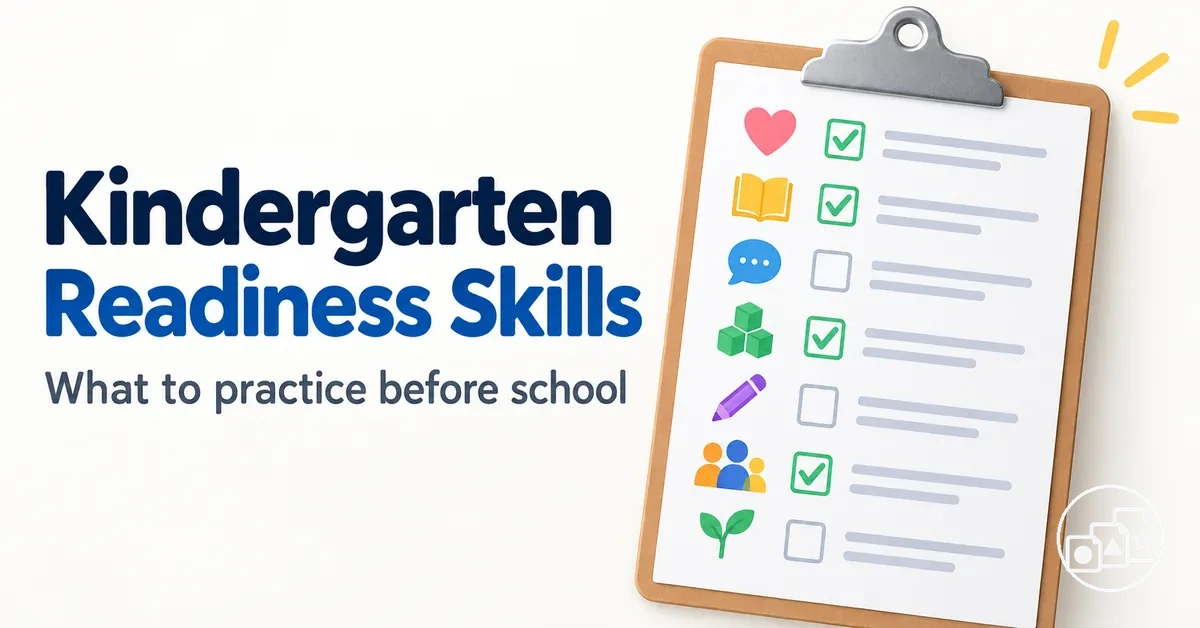
Kindergarten readiness at a glance
Use this practice map to organise what you notice before school. Each domain describes observable participation and developing skills; it is not a scored test.
Familiar numerals, counting with one-to-one correspondence, quantities, sorting, patterns, shapes and comparison language.
Intentional marks, simple lines and shapes, tool control, two-hand coordination and small-object manipulation.
Understanding spoken information, expressing needs and ideas, asking questions and taking conversational turns.
Turn-taking, cooperation, group participation, expressing feelings, recovering from frustration and seeking help.
Participating in toileting where applicable, handwashing, eating, dressing and managing familiar belongings.
Walking, running, jumping, balance, stairs and whole-body movement in familiar routines and play.
Listening to directions, transitions, task persistence, clarification, trying again and using support when needed.
How to interpret any checklist item
- Support
- Notice whether the skill is independent, appears after a prompt or model, or needs more direct assistance.
- Consistency
- Look for the pattern across comparable opportunities rather than judging one attempt.
- Familiarity
- Separate performance in a familiar routine from performance in a new task, place or version of the activity.
- Functional impact
- Consider whether the skill helps or limits participation in the routine the child is trying to complete.
Practice rule: give extra practice to skills that are emerging, inconsistent or need more support in familiar routines, while continuing ordinary opportunities to use skills that are already independent.
Different skill domains can develop at different rates, and the support a child needs can change with the task, setting and familiarity.
Table of Contents
Skills to Practise Before Kindergarten
Useful practice before kindergarten covers both academic skills and non-academic skills that can be observed during familiar tasks and everyday routines.
Observable skills are concrete behaviours a child can demonstrate independently or with support, making them useful practice targets rather than formal assessment results.
The relevant skill domains include literacy, numeracy, communication, motor, self-care and social-emotional abilities.
The grouped checklist focuses on behaviours that can be practised and noticed within each skill domain, not on a fixed level of mastery.
The illustration represents different kinds of readiness practice across academic, motor and everyday activities rather than a required sequence.
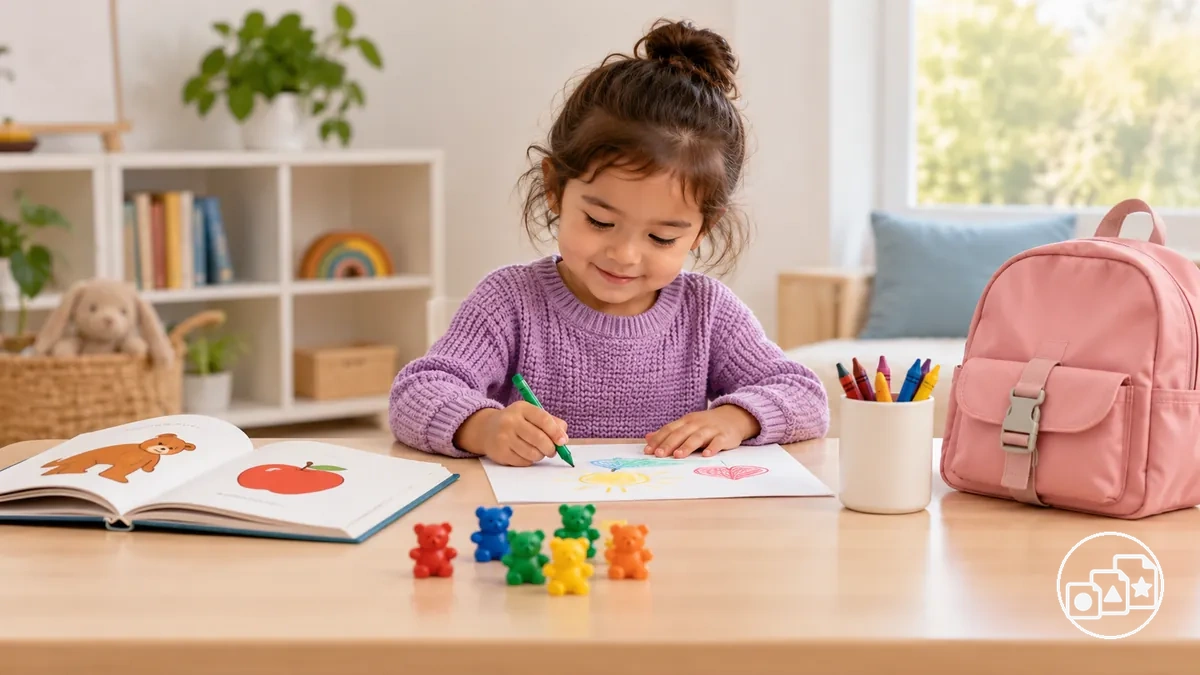
A checklist item can be read by noticing whether the behaviour appears during a familiar task and whether the child completes it independently or may need support.
The amount of support or consistency can differ with the task, setting and familiarity, so an individual behaviour is best treated as a developing skill to observe and practise rather than a readiness threshold.
Practice methods can vary while the observable skill remains the focus.
Some readiness skills can be practised through kindergarten readiness worksheets, while other skills are more naturally observed and supported through conversation, play, movement, self-care and familiar daily tasks.
Early Literacy and Letter Awareness
Early literacy and letter awareness include developing familiarity with books, print meaning, spoken language and letters before independent reading develops.
Early literacy readiness can involve print awareness, letter recognition, phonological awareness, vocabulary and narrative skills.
These emerging abilities can be observed without expecting a child to read fluently.
Recognising some familiar letters is one part of this broader readiness profile rather than a universal letter-count standard.
The examples below sample early print, letter and language awareness rather than define a reading standard.
The image shows how books, visible print and spoken sound or storytelling can provide observable literacy cues.
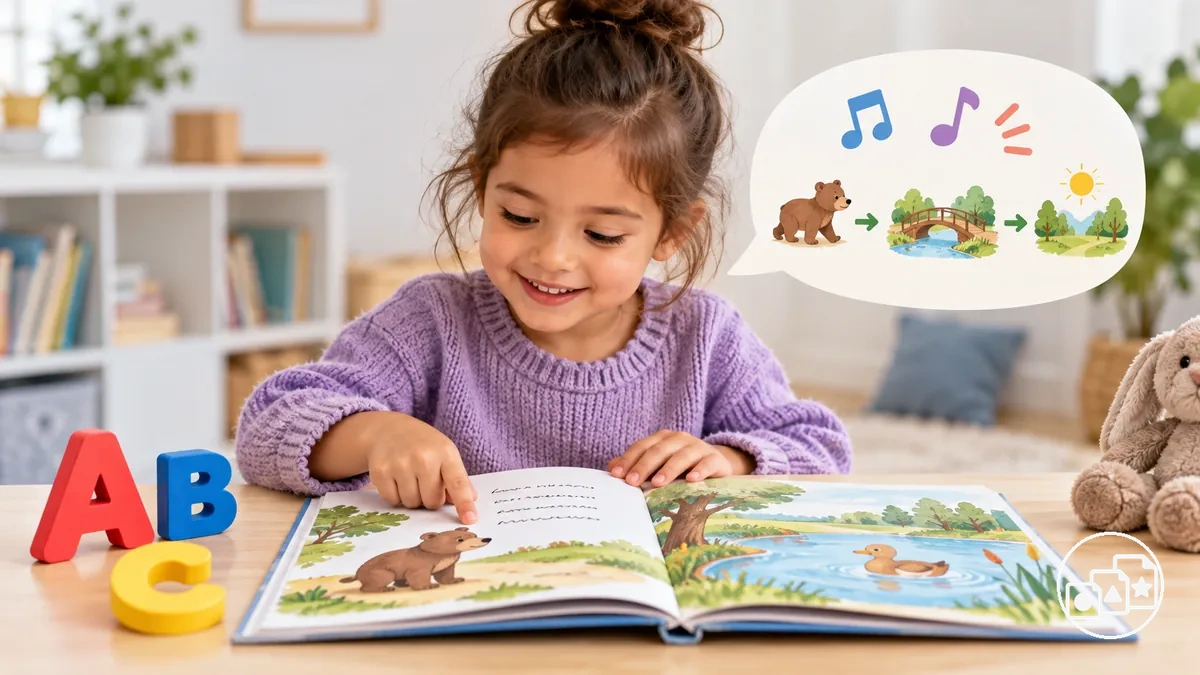
- Shows interest in books and attends to pictures or printed words during shared reading.
- Shows print awareness by noticing that written marks and words carry print meaning.
- Recognises some familiar letters, such as letters seen often in a name or familiar print.
- Joins in with rhyme, syllables or simple sound play, showing emerging phonological awareness.
- Uses growing vocabulary to name, describe or talk about familiar people, objects and experiences.
- Uses emerging narrative skills to retell parts of a familiar story or describe what happened in a simple sequence.
Early literacy readiness is broader than independent reading: a child can show developing print, sound, vocabulary and story awareness without yet reading text independently.
Letter recognition is one component of this broader profile, while detailed practice with letter recognition skills belongs to the narrower letter-focused context.
Number Recognition and Early Math Concepts
Early numeracy skills include number recognition, counting, quantity relationships, sorting, patterns, shapes and simple measurement ideas.
Number recognition involves noticing or naming some familiar numerals, while counting can involve both saying a counting sequence and matching number words to objects.
One-to-one correspondence connects each counted object with one number word and supports understanding of quantity.
These abilities can develop with different levels of consistency, so no single required number range defines numeracy readiness.
The checklist samples different kinds of early mathematical thinking rather than a required score or ranked sequence.
The image pairs numerals with concrete quantities and related grouping cues to make the relationship between number symbols and counted objects visible.
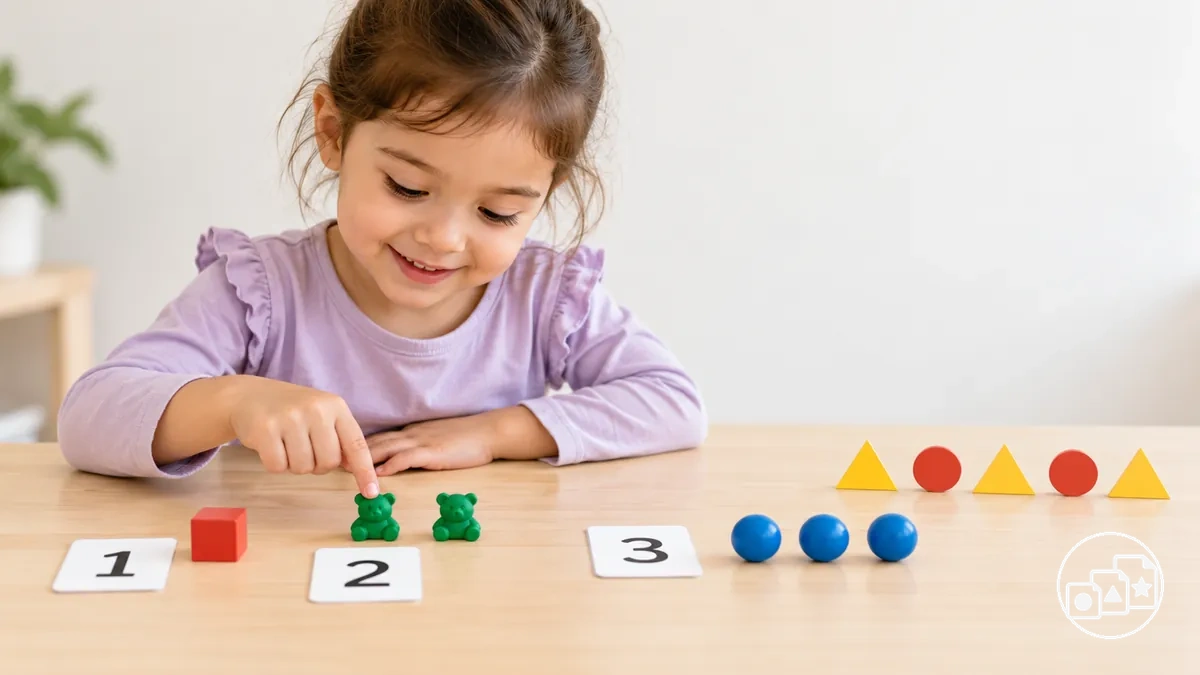
- Recognises some familiar numerals when they appear in everyday print, games or activities.
- Recites part of a familiar counting sequence using number words in order.
- Counts a small group of familiar objects by matching one number word to each object through one-to-one correspondence.
- Compares familiar groups of objects and notices differences in quantity, such as which group has more, fewer or the same amount.
- Sorts or classifies familiar objects by an observable attribute such as shape, size or type.
- Notices or continues simple repeating patterns using familiar objects, movements or sounds.
- Identifies common shapes in familiar objects or pictures.
- Uses simple comparison or measurement language, such as longer, shorter, heavier or lighter, when describing familiar objects.
Reciting number words
Saying number words in order shows familiarity with a counting sequence, but it does not by itself show quantity understanding.
Counting objects
Matching one number word to each object through one-to-one correspondence connects the spoken sequence with how many objects are being counted.
Numeral recognition and counting are therefore parts of broader early numeracy, while focused practice with number recognition and counting skills belongs to the narrower number-focused context.
Pre-Writing and Fine Motor Control
Pre-writing and fine motor control involve the hand control, hand-eye coordination and visual-motor control used for early mark-making and common classroom tasks.
Developing control can be observed when a child makes intentional marks, copies simple lines or shapes and handles drawing tools with increasing control.
Bilateral coordination also supports actions in which both hands work together, while manipulating small objects and cutting involve related fine motor control.
These are foundational writing-readiness actions rather than measures of handwriting mastery or one required pencil grasp.
The checklist groups observable actions that show underlying hand control rather than the quality of finished handwriting.
The image demonstrates early mark-making with a drawing tool and simple forms, making the relationship between fine motor control and pre-writing visible.
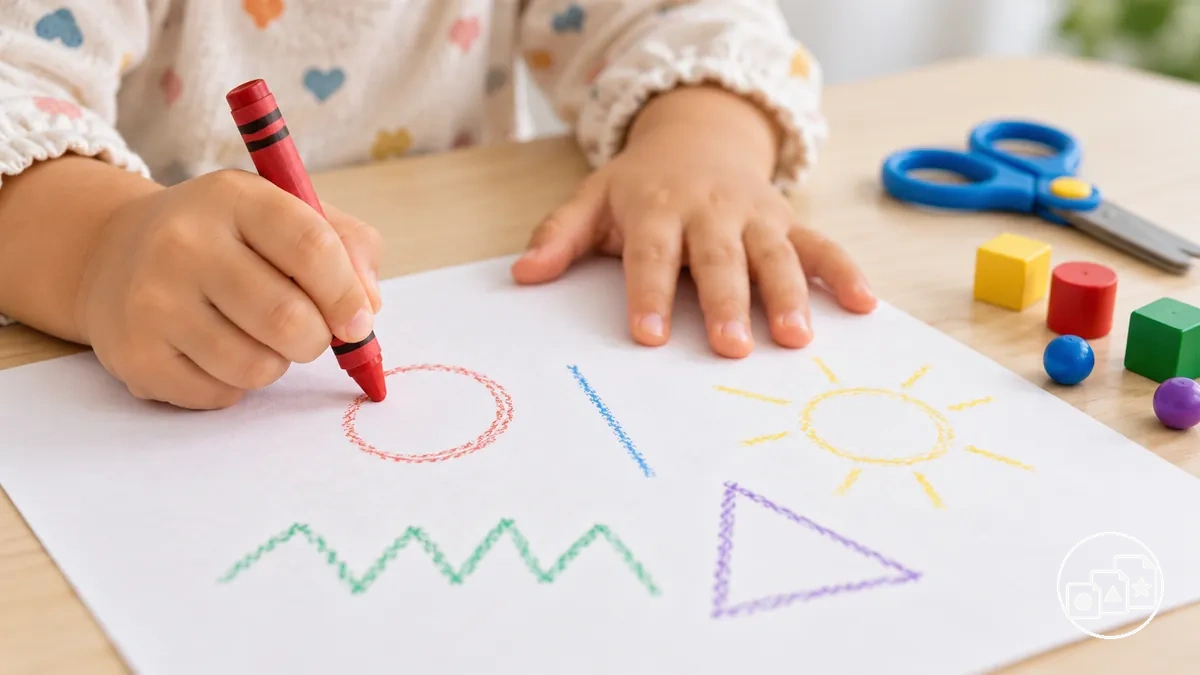
- Makes controlled scribbles, marks or simple strokes with a crayon, pencil or other drawing tool.
- Copies or attempts simple lines and shapes from a visible example.
- Uses drawing tools with enough control to direct marks intentionally across a page.
- Uses bilateral coordination during tasks in which one hand stabilises an object while the other hand acts on it.
- Manipulates small objects with the fingers during familiar classroom or play tasks.
- Uses child-safe scissors to make simple cutting movements when the activity and level of support are appropriate.
These actions reflect developing control for early mark-making and tool use rather than a requirement for polished letter formation.
Foundational pre-writing control is different from polished handwriting: intentional mark-making, copying simple forms and coordinating tools can be developing before letter formation becomes consistent.
Fine motor control supports these early actions, while detailed practice with pre-writing skills belongs to the narrower pre-writing context.
Language and Communication
Language and communication skills support functional communication by helping a child understand others and express needs during familiar situations.
Receptive language
Understanding spoken information, such as a short explanation or a familiar direction, and responding in a way that shows comprehension.
Expressive language
Communicating needs, choices or ideas, answering or asking questions, and sharing information in an understandable way.
These communication skills can be demonstrated in different ways and do not depend on a required sentence length or one style of speaking.
Observable communication can include both receiving information and expressing it during familiar interactions, rather than speaking fluently being the only signal.
The image illustrates a familiar conversation in which a child listens and responds, making receptive and expressive communication visible without treating either as a scored ability.
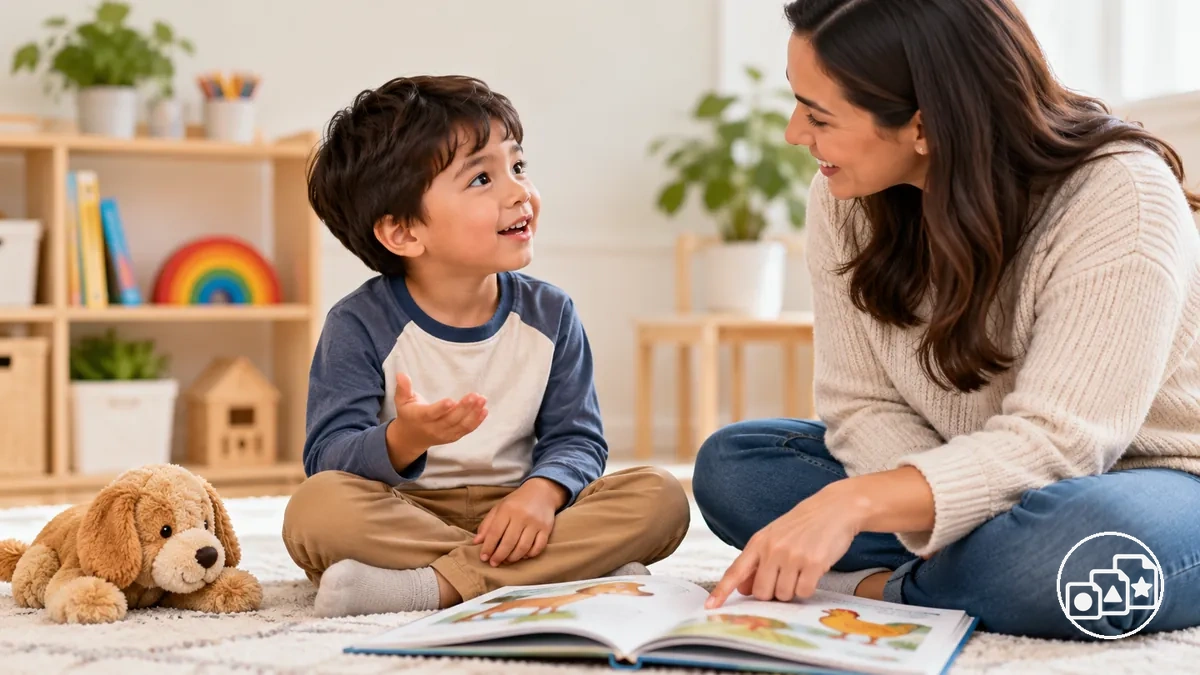
- Listens to a short explanation or familiar direction and shows understanding through an appropriate response or action.
- Answers simple questions about familiar people, objects, activities or experiences.
- Expresses needs, choices or ideas in a way that another person can understand in a familiar situation.
- Asks simple questions to seek information, clarification or help.
- Participates in conversational turns by listening while another person communicates and responding when appropriate.
- Retells a simple familiar event or part of a story when able.
Social and Emotional Readiness
Social and emotional readiness includes developing emotional regulation, cooperation, participation and help-seeking during interactions with adults and peers.
A child may show these social-emotional skills through turn-taking, sharing when appropriate, joining a group activity, expressing feelings or needs, and seeking adult support.
How consistently these behaviours appear can vary with familiarity, stress and the support available in the situation.
The checklist focuses on observable participation rather than judging personality or requiring every behaviour to occur independently.
Familiarity, stress and available adult support can change how a child responds in a particular situation.
- Participates in turn-taking with peers during familiar play or group activities.
- Shows cooperation through sharing materials or working alongside peers when the activity calls for it.
- Joins or participates in a familiar group activity with the level of support needed in that situation.
- Expresses feelings or needs in a way that helps others understand what support or response may be useful.
- Recovers from ordinary frustration with support and returns to participation when able.
- Uses help-seeking by approaching a trusted adult when assistance or reassurance is needed.
These behaviours are context-sensitive, so needing support or showing a skill inconsistently does not by itself define overall social and emotional readiness; the useful observation is how the child participates and regulates within familiar situations.
Self-Care and Independence
Self-care and independence describe how a child participates in familiar school routines by managing practical tasks independently or with appropriate assistance.
These routines can include toileting where applicable, handwashing, eating, dressing and managing belongings.
The level of independence expected for a particular task may vary with the school context and the child's individual needs.
Asking for help when assistance is needed can therefore be part of everyday independence rather than a failure to manage a routine.
The checklist focuses on routine tasks that can reduce practical barriers to classroom participation, while recognising that the level of assistance may differ by task and setting.
Expectations for specific routines can vary by school context and individual needs.
- Participates in toileting routines where applicable, managing familiar steps independently or requesting assistance when needed.
- Completes familiar handwashing steps with the level of prompting or assistance needed to participate in the hygiene routine.
- Manages familiar eating tasks, such as using usual utensils or opening familiar containers, independently or with appropriate help.
- Participates in dressing tasks, such as managing familiar clothing or footwear, with assistance when a step is not yet independent.
- Manages simple belongings during familiar routines, such as locating, carrying or putting away personal items with the support needed.
- Asks for help when a self-care task, container, clothing item or belonging cannot be managed independently.
Managing a task independently and completing it through appropriate help-seeking can both support classroom participation in familiar routines.
Gross Motor Coordination
Gross motor coordination describes the gross motor skills used to control whole-body movement during ordinary play, transitions and physical classroom routines.
It includes actions such as maintaining balance, running, jumping and coordinating movement while navigating familiar spaces.
These movement skills support participation in activities such as moving between areas, using stairs and joining playground movement.
Functional coordination concerns practical movement for participation rather than athletic performance.
The checklist focuses on observable whole-body actions used in familiar play and school routines, not sport performance.
The amount of control or support involved may differ with the activity, environment and familiarity.
- Walks and runs with enough control to navigate familiar play areas and routine transitions.
- Jumps during familiar movement or play activities while coordinating the body for take-off and landing.
- Uses balance when standing, changing direction or moving across familiar playground surfaces.
- Navigates stairs or similar changes in level with the support appropriate to the setting.
- Coordinates whole-body movement during familiar playground movement, such as moving around equipment or other people.
- Uses emerging ball skills, such as throwing, catching or kicking during familiar play, with the level of coordination appropriate to the activity.
Performance can vary with the movement task, familiarity of the setting and available support, so the relevant observation is how gross motor coordination supports participation in ordinary routines and play.
Attention, Following Directions and Learning Behaviours
Learning behaviours include attention, following directions and task persistence that support participation in short, familiar tasks and classroom routines.
A child's listening, engagement and persistence may vary with the meaning of the task, interest, familiarity, task demand and available support.
Following directions can involve responding to familiar steps and asking for clarification when an instruction is unclear.
The checklist focuses on observable responses during familiar tasks rather than fixed attention-duration or performance requirements.
These behaviours show how a child engages with instructions, transitions and small challenges under the conditions of a particular activity.
- Listens to a simple instruction during a familiar task and responds in a way that supports participation.
- Follows one or more familiar steps as appropriate to the task, with prompting or support when needed.
- Asks for clarification or assistance when a direction is unclear or a familiar step is not understood.
- Shifts between familiar activities or transitions with the level of preparation and support needed in that situation.
- Shows task persistence by staying engaged with a short, meaningful task while interest and task demands remain manageable.
- Tries again after a small difficulty, independently or with encouragement, to continue participating in a familiar task.
Attention and task persistence may look different when a task is unfamiliar, less interesting or more demanding than when it is familiar and meaningful.
The amount of support needed can therefore change across activities, so one difficult situation does not by itself define a child's overall learning behaviours.
Readiness Expectations Across the Skill Categories
Readiness expectations should be interpreted through the level of support, consistency, familiarity and functional impact rather than by calculating a total score.
A readiness profile can contain strengths and emerging skills at the same time, and the meaning of an observation may change when the task or support changes.
Interpretation should therefore consider the conditions under which a capability appears and what it means for participation or useful practice.
Academic observations are part of this profile alongside communication, self-care, social participation and other readiness skills rather than automatically carrying greater weight.
Four dimensions help organise checklist observations consistently across skill categories.
Each dimension connects an observed capability with the conditions in which it appears and its practical significance.
- Level of support
- Consider whether the child manages the skill independently, with a prompt or with more direct assistance, because the support needed helps identify an appropriate level of practice.
- Consistency
- Consider whether the skill appears repeatedly in comparable situations or only sometimes, because inconsistent performance may indicate that the capability is still emerging.
- Familiarity
- Consider whether the skill appears during a familiar situation and whether performance changes when the task or setting is less familiar.
- Functional impact
- Consider how the observed capability affects participation in relevant routines or activities, because the practical significance of an emerging skill depends on what the child is trying to do.
What to practise next: prioritise a skill when it is still emerging, inconsistent, or requires more support in a familiar routine. Keep providing normal opportunities to use skills that are already independent; do not turn the checklist into a total score.
For example, a child might show strengths in familiar conversation, self-care routines and recognising some letters while needing support to shift between activities or persist with a less familiar task.
That uneven profile combines established and emerging skills rather than representing a failing total.
Practice can therefore focus on the emerging skills and the conditions in which additional support is useful without discounting strengths in other domains.
Checklist interpretation describes an observed readiness pattern; it does not provide the deeper examination needed to determine why a skill is inconsistent or difficult across contexts.
When an uneven profile warrants closer examination rather than a checklist score, a more focused process can identify kindergarten readiness skill gaps by examining the relevant skills and conditions in greater detail.
Emerging Skills With Support
Performance with ordinary support such as modelling, reminders or repetition can indicate an emerging skill.
Supported performance shows developing ability when a child can complete or participate in part of a task with assistance, even when the same skill is not yet shown consistently without support.
Interpretation should consider the type of support needed and the consistency of the observed performance rather than treating support need as a diagnostic verdict.
Performance may also vary with fatigue, novelty, environment and familiarity.
To interpret an emerging skill with support, consider what the child can do during a familiar task, what support is needed and how consistently the skill appears.
These criteria help connect observed performance with an appropriate focus for practice.
- Modelling
- If the child can perform the skill after seeing the action demonstrated, the observed performance may indicate a developing skill that still requires a visible example.
- Reminders
- If a familiar skill appears after a verbal or visual reminder, the support needed may indicate partial independence while consistency is still developing.
- Repetition
- If repeating an instruction or giving another opportunity helps the child perform the skill, consider whether the response becomes more consistent during familiar tasks.
- Changing conditions
- If support needs vary with fatigue, novelty, environment or familiarity, practice can focus on the conditions in which the emerging skill requires additional support.
For example, a child may complete a familiar classroom routine after one reminder but need modelling when the task is new, showing that the support needed can vary by task while the underlying skill continues to develop.
Independent Skills in Familiar Situations
Independent performance means completing a familiar task with little or no direct assistance under ordinary conditions.
An independent skill can show consistency in a familiar situation while still requiring occasional support when circumstances change.
The level of prompting needed helps describe familiar-task independence without requiring perfect consistency.
Independence can also differ by skill domain and may not transfer unchanged to a new or less familiar setting.
Interpret independent performance by considering the familiarity of the task, the prompting or assistance involved and whether the skill appears consistently enough to support participation.
These criteria keep independence tied to the conditions in which the skill is observed rather than assuming the same performance in every setting.
- Familiarity
- When a child completes a familiar task under ordinary conditions, the observed independence applies to that familiar situation and should not automatically be generalized to a new context.
- Prompting level
- Performing the task with little assistance or without direct prompting indicates greater independence within that familiar context, while occasional help does not invalidate the skill.
- Consistency
- Repeated independent performance in comparable familiar situations can show consistency without requiring the child to perform identically every time.
- Transfer
- If the same skill requires more support in a new environment or a less familiar version of the task, the change in support needs limits how broadly the familiar-task independence can be interpreted.
For example, a child may independently put away familiar belongings during a usual classroom routine but need prompting when the storage location or routine changes, showing familiar-task independence without assuming unchanged transfer to the new situation.