
Pre-Writing Skills for Kindergarten Readiness
Pre-writing skills are handwriting-readiness abilities that help a child control a writing tool, produce purposeful strokes, and reproduce simple shapes before conventional letter and number formation. For kindergarten readiness, look for a pattern of increasing control and independence across tasks rather than one grip, shape, worksheet result, age cutoff, or pass/fail score.
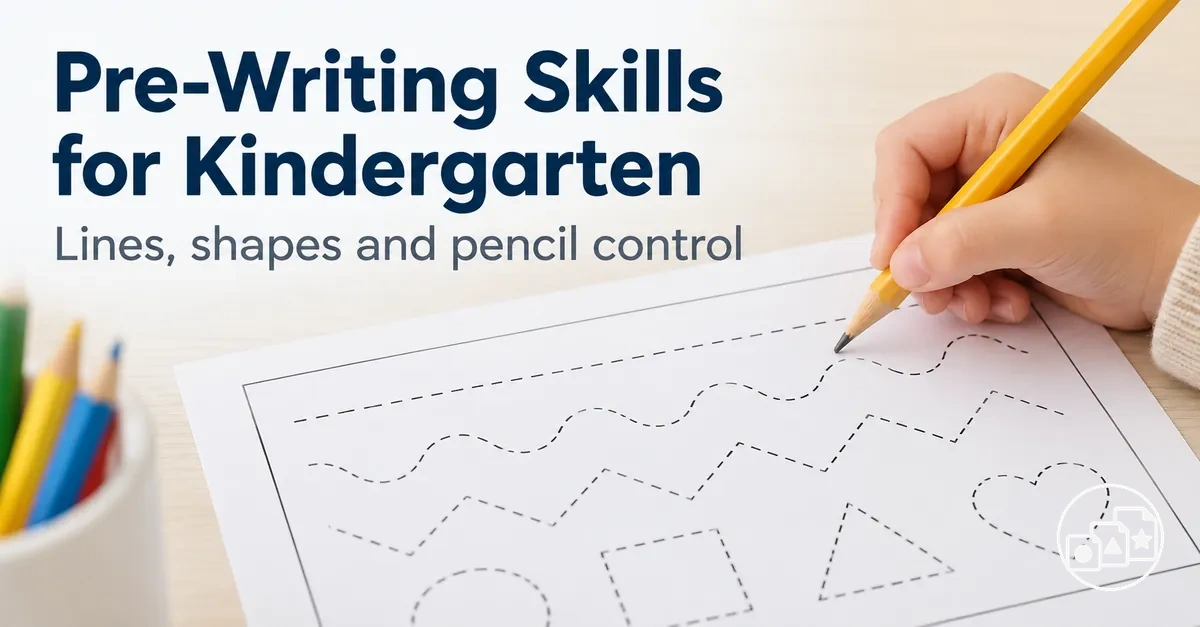
Pre-writing readiness at a glance
Read readiness as a connected pattern: tool control supports directed strokes, directed strokes combine into simple shapes, and the amount of guidance shows how independently the child can reproduce them.
1 · Tool control
Direct the pencil toward an intended path or target, including following a tracing path or staying on or between lines.
2 · Stroke control
Produce horizontal, vertical, diagonal, curved or circular, and intersecting movements with an intended direction.
3 · Shape reproduction
Combine or close strokes to reproduce forms such as a circle, cross, square, X, or triangle from visual guidance.
How support changes the task
- Imitation
- A demonstration supplies the movement model.
- Tracing
- An existing path guides the movement.
- Copying
- A visible model remains, while the child organizes more of the movement independently.
Interpret the pattern, not one result: performance can differ by task and support level, so one difficult shape or worksheet does not define overall handwriting readiness.
Here, pre-writing means handwriting-readiness skills, not the composition-stage process that is also called prewriting.
Table of Contents
What Pre-Writing Skills Mean for Handwriting Readiness
Pre-writing skills are foundational handwriting-readiness abilities used before a child forms conventional letters and numbers with control. They develop intentional mark-making by linking what the child sees with how a writing tool moves.
What it is
Control of a writing tool through purposeful mark-making, including pencil control, tracing and forming basic strokes, and reproducing simple shapes.
What it is not
Conventional handwriting or mastery of letters and numbers. Pre-writing develops the control used before those written symbols are formed consistently.

Controlled marks show how deliberately a child can direct a writing tool. Pre-writing readiness supports later letter and number formation, but it is not conventional handwriting itself.
The Core Pre-Writing Skills Before Kindergarten
Core pre-writing skills can be grouped into three related but distinct control demands: controlling the writing tool, controlling the direction of movement, and reproducing a visible form.
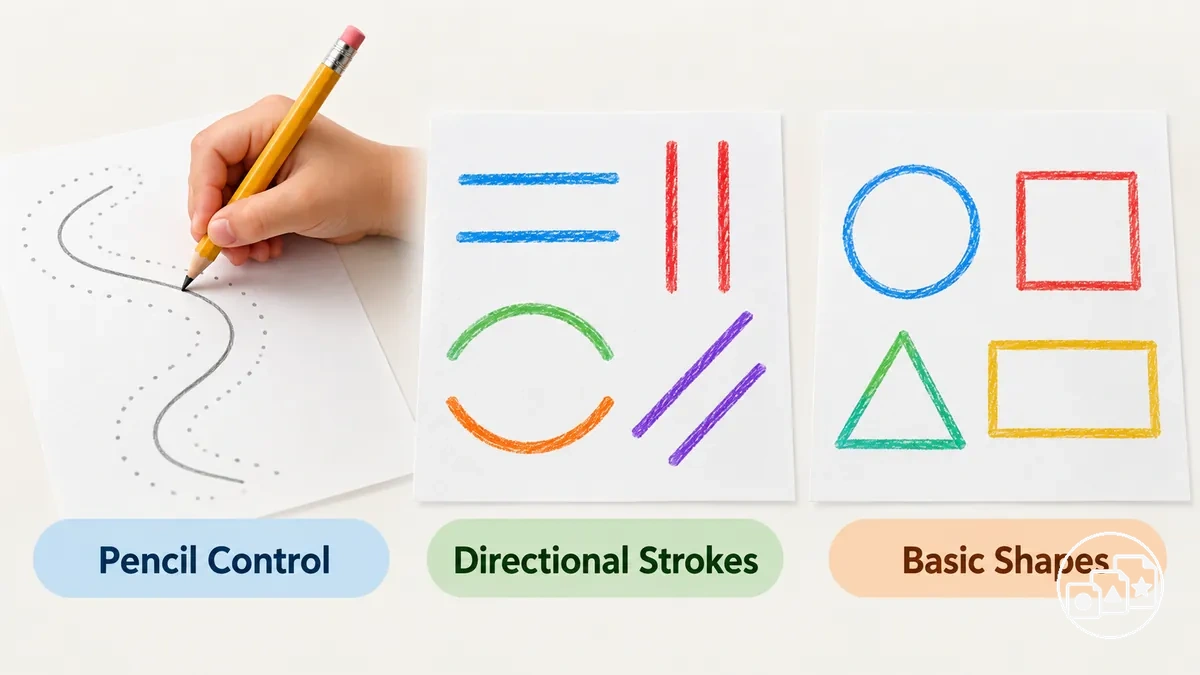
- Pencil control: controls the writing tool so marks can follow an intended path with increasing precision.
- Directional strokes and lines: organize movement in an intended direction to produce controlled marks rather than undirected movement.
- Basic shapes: combine controlled movements to reproduce a simple form from a visual model.
Together, these components connect tool control, directed movement, and form reproduction. A child may show different levels of control across them, so their order is not a fixed milestone sequence.
Pencil Control for Deliberate Mark-Making
Pencil control is the ability to grasp and manipulate a writing tool well enough to make intentional marks and direct the tool toward a target, rather than merely hold it.
It becomes observable when a child follows a tracing path, stays on or between lines, and coordinates movement with a visual target. These tasks use hand-eye coordination to connect what the child sees with where the writing tool moves.
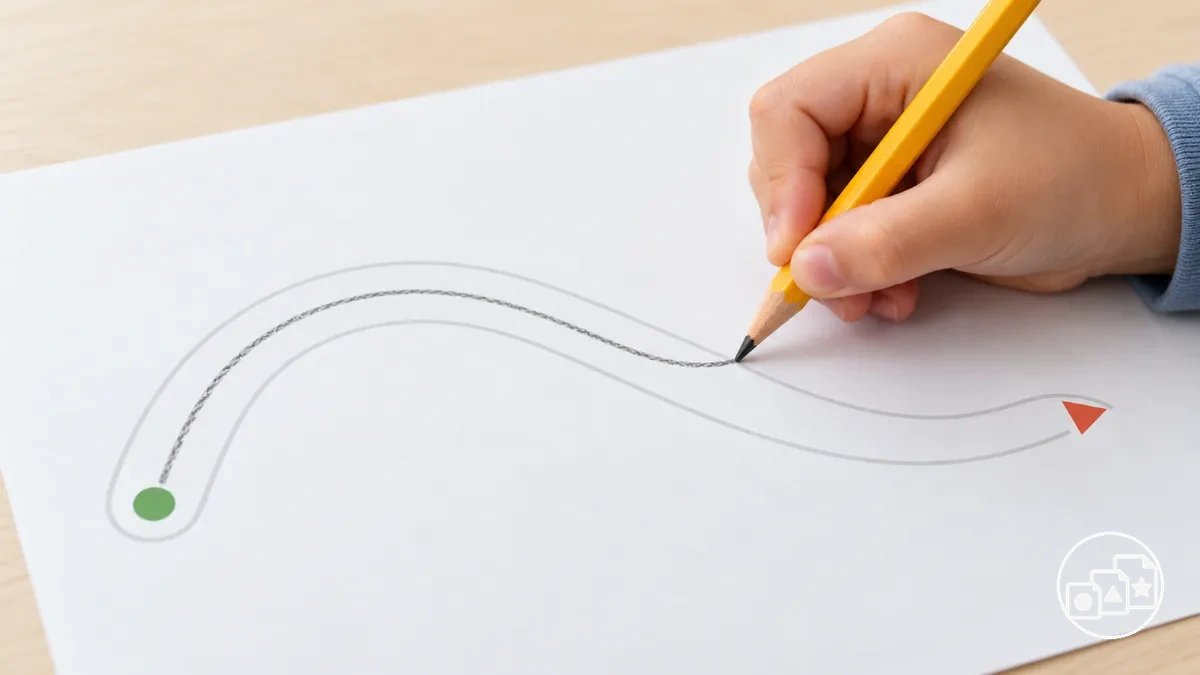
The resulting marks can show how precisely the child directs the pencil without requiring one prescribed grip pattern.
What to observe
- Directs the writing tool toward an intended mark or target.
- Follows a simple tracing path with increasing precision.
- Stays on or between lines while controlling the pencil's movement.
- Coordinates hand movement with the visual target during controlled mark-making.
Pencil control focuses on deliberate tool manipulation, while hand strength and coordination belong to the broader context of fine motor skills for kindergarten readiness. Those supporting abilities can contribute to controlled mark-making without defining pencil control by one grip pattern.
Pre-Writing Strokes and Line Directions
Pre-writing strokes are movement forms defined by direction and path. Horizontal, vertical, and diagonal lines each follow a straight directional path, while curved or circular movement changes direction continuously and intersecting strokes combine paths that cross.
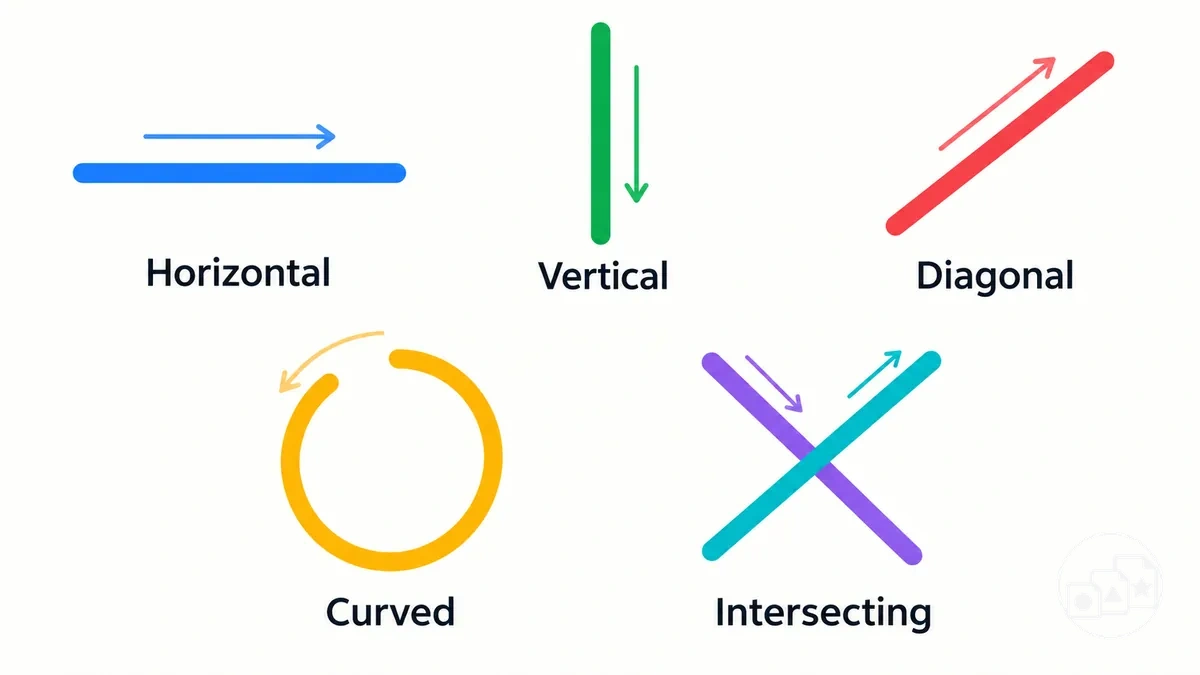
These patterns provide movement forms that can later appear within letters, numbers, and simple drawings.
- Horizontal line: moves sideways along one direction, providing a straight left-to-right or right-to-left movement pattern.
- Vertical line: moves upward or downward along one direction, distinguishing vertical control from sideways movement.
- Diagonal line: moves on a slant, requiring direction to change across both horizontal and vertical space.
- Curved or circular movement: bends or continues around a curve, requiring ongoing directional adjustment rather than one straight path.
- Intersecting strokes: combine movements that cross, as in a cross or X, connecting separate directional paths within one form.
Basic Shapes Built from Pre-Writing Strokes
Basic pre-writing shapes combine, intersect, or close earlier strokes to form recognizable forms: a circle closes a curved stroke, a cross and X combine intersecting strokes, and a square or triangle combines straight strokes with changes in direction.
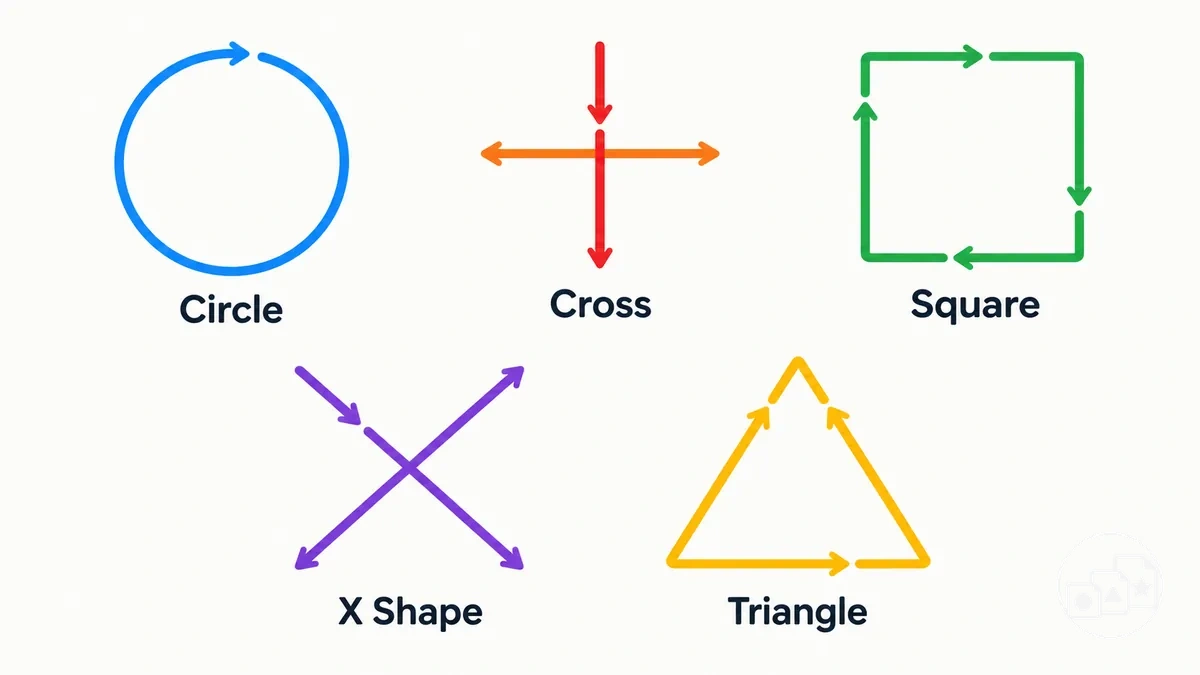
- Circle: closes a continuous curved stroke to reproduce a rounded form.
- Cross: combines intersecting horizontal and vertical strokes within one recognizable form.
- Square: combines straight strokes and directional changes to close a four-sided form.
- X shape: intersects two diagonal strokes, requiring their paths to cross within the reproduced form.
- Triangle: combines three straight strokes with directional changes to close the form.
Copying a basic shape requires the child to use a visual model while coordinating directional control across multiple strokes.
How Pre-Writing Skills Progress Toward Handwriting
Pre-writing progression is better described through changing intentional control, external support, and independence than through one fixed developmental timetable.
- Intentional control
- Marks become more deliberate as the child directs movement toward an intended path, stroke, or form.
- External support
- Support can range from a movement demonstration to an existing tracing path or a visible model.
- Independence
- The child organizes more of the reproduction as direct guidance decreases, but independence can increase unevenly across tasks.
A child may show strong control on one task while needing more support on another. One difficult task does not by itself define overall handwriting readiness.
From Scribbling and Mark-Making to Controlled Strokes
The key change is from exploratory marks toward purposeful movement with an intended direction.
- Exploratory mark-making: marks may be spontaneous without reproducing a specific line or path.
- Controlled mark-making: the child directs movement toward a simple line or demonstrated form, making intentional control easier to observe.
- Imitated direction: after seeing a horizontal line demonstrated, the child attempts a deliberate sideways mark; the mark can show intentional reproduction even when its shape is not exact.
These observable changes describe how marks become more controlled without assigning the change to a fixed age.
From Imitating and Tracing to Copying Shapes
Imitation, tracing, and copying differ mainly in the type and amount of support provided. Keeping the same target shape across the three tasks helps separate a change in support from a change in the form being reproduced.
As direct guidance decreases, the child organizes more of the reproduction independently. This sequence describes task demands rather than a rigid age timetable.
- Imitation: The child follows a demonstration of the movement used to reproduce the circle.
- Tracing: The child follows an existing line or shape, using its path as guidance.
- Copying: The child reproduces the circle from a visible model without a movement demonstration, requiring less direct support.
Signs of Pre-Writing Readiness Before Kindergarten
Pre-writing readiness is best interpreted as a pattern across observable behaviours, not as one isolated task. Look at purposeful mark-making, writing-tool control, stroke direction, shape reproduction, and how much support the child needs.
The checklist below summarises functional signs across those skill areas without turning readiness into a score.
- Interest in mark-making: The child willingly makes purposeful marks, suggesting engagement with intentional mark-making.
- Writing-tool control: The child directs a writing tool toward an intended path or area with some control.
- Stroke production: The child produces simple strokes with an intended direction rather than only exploratory movement.
- Tracing: The child follows an existing line or shape while using the visible path for support.
- Copying shapes: The child imitates or copies a simple visible shape with growing independence and less direct support.
These signs cover one functional area within the broader set of kindergarten readiness skills; they are not a complete kindergarten-readiness assessment.
Use the observed pattern to choose kindergarten readiness worksheet practice that matches the child's current control and independence.