
Why Children Struggle With Kindergarten Readiness Worksheets
Children can struggle with kindergarten readiness worksheets for several different reasons: the target readiness skill may not yet be secure, the worksheet may demand more than the child can currently manage, the format or pencil-and-paper response may add extra difficulty, or temporary conditions such as attention, fatigue or frustration may affect performance. The most useful clue is whether the difficulty follows the same skill across suitable formats or changes when task demand, presentation, response mode or conditions change; one poor worksheet result does not identify the cause.
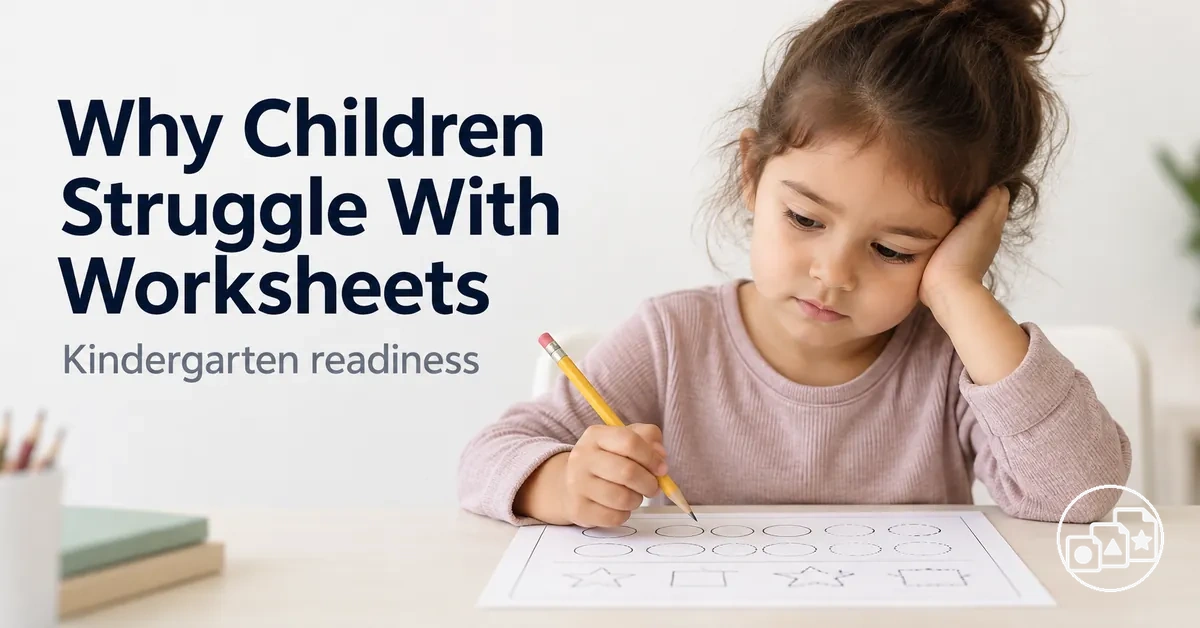
Pattern-based guide
Interpret the pattern, not the symptom
Keep the target skill as constant as possible, change one demand at a time, and compare repeated performance. The direction of change helps identify which contributor is more plausible.
- ObserveRecord completion, accuracy, prompting, persistence and consistency.
- CompareAsk the child to show the same skill in another suitable format or under a changed condition.
- InterpretUse the repeated pattern to choose the next check or adjustment, not to make a diagnosis.
Important boundary: mixed evidence can remain mixed. A child can have an emerging skill and also find a particular worksheet unusually demanding.
Start with the observable work pattern, then compare the same target skill across suitable formats and conditions before deciding what the worksheet difficulty is most likely to mean.
Table of Contents
How Worksheet Difficulty Shows Up in a Child's Work
Observable worksheet performance shows difficulty through what a child does during a worksheet task, not through an assumed cause.
An observable sign may include unfinished work, mistakes, frequent prompting, reduced persistence, or performance that changes from one task to another.
A repeated pattern across comparable tasks is more informative than an occasional difficult session, but the pattern still requires interpretation rather than being treated as proof of a particular problem.
Observe these five attributes together
- Completion
- Whether the task is finished, partly finished, or repeatedly stopped and restarted.
- Accuracy
- The pattern of correct responses, repeated errors, isolated slips and self-corrections.
- Prompting
- How much clarification, reminding or assistance is needed to continue.
- Persistence
- Whether the child continues, pauses repeatedly, or stops as the task becomes harder.
- Consistency
- Whether the same pattern repeats across comparable tasks or appears only occasionally.
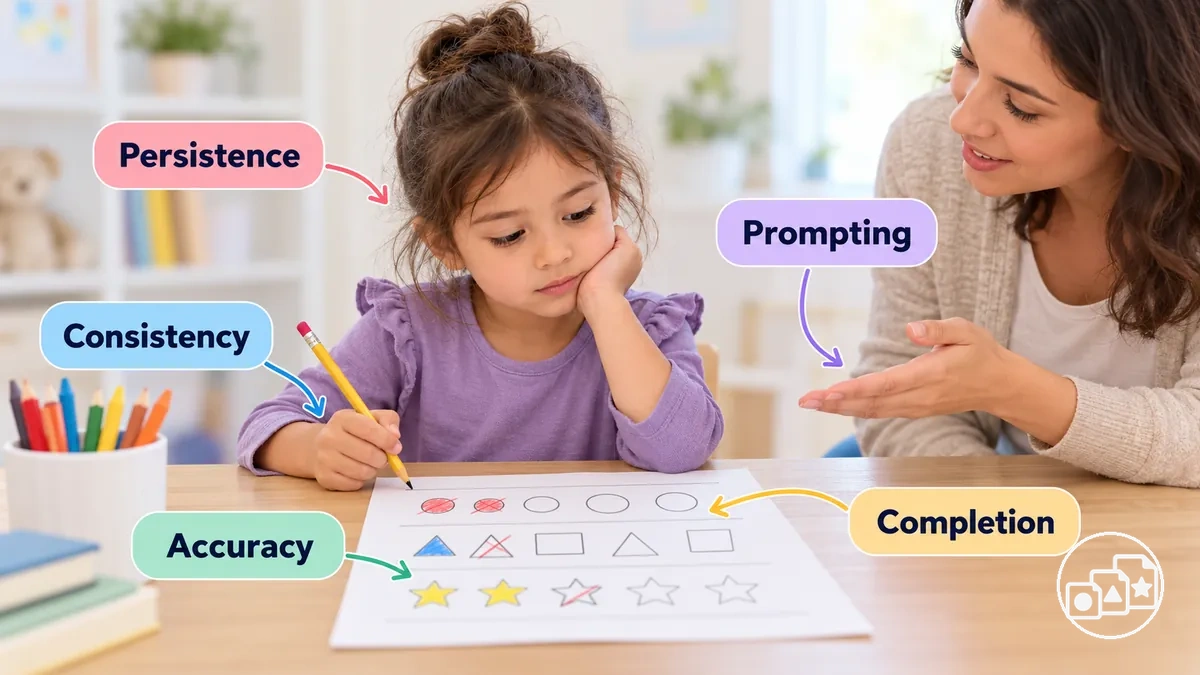
Consistency adds an important distinction because the same visible difficulty may form a repeated pattern across suitable tasks or appear only occasionally.
For example, two children may both leave part of a worksheet unfinished, yet that observed behaviour alone does not establish the same explanation for both; recording the work pattern first preserves the distinction between observation and inferred cause.
Taking a Long Time or Leaving Worksheets Unfinished
A worksheet completion pattern matters only when completion time is considered alongside task length, task complexity, familiarity, and the child's usual performance.
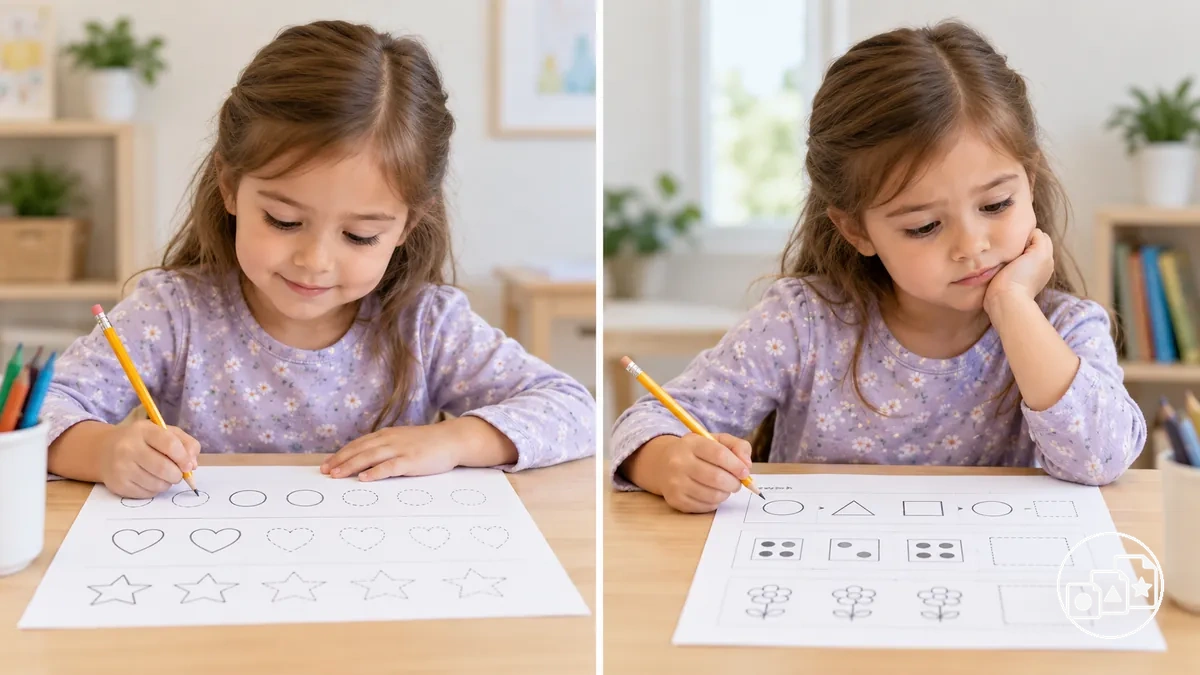
Compare the completion pattern
Repeated across comparable tasks
Taking longer, stopping, restarting, losing place or needing help on similar familiar tasks is a persistent completion pattern worth observing more closely.
Appears on one unusually demanding task
If the child usually works at their normal pace but stops when complexity or task length increases, the task condition may be contributing to that attempt.
Neither pattern by itself proves low ability, poor motivation, or a specific processing problem.
Frequent Mistakes or Uneven Accuracy
A worksheet error pattern is more informative than the raw number of mistakes because accuracy depends on whether repeated errors occur in the same way across similar items.
A high number of errors alone is not proof of a skill gap.
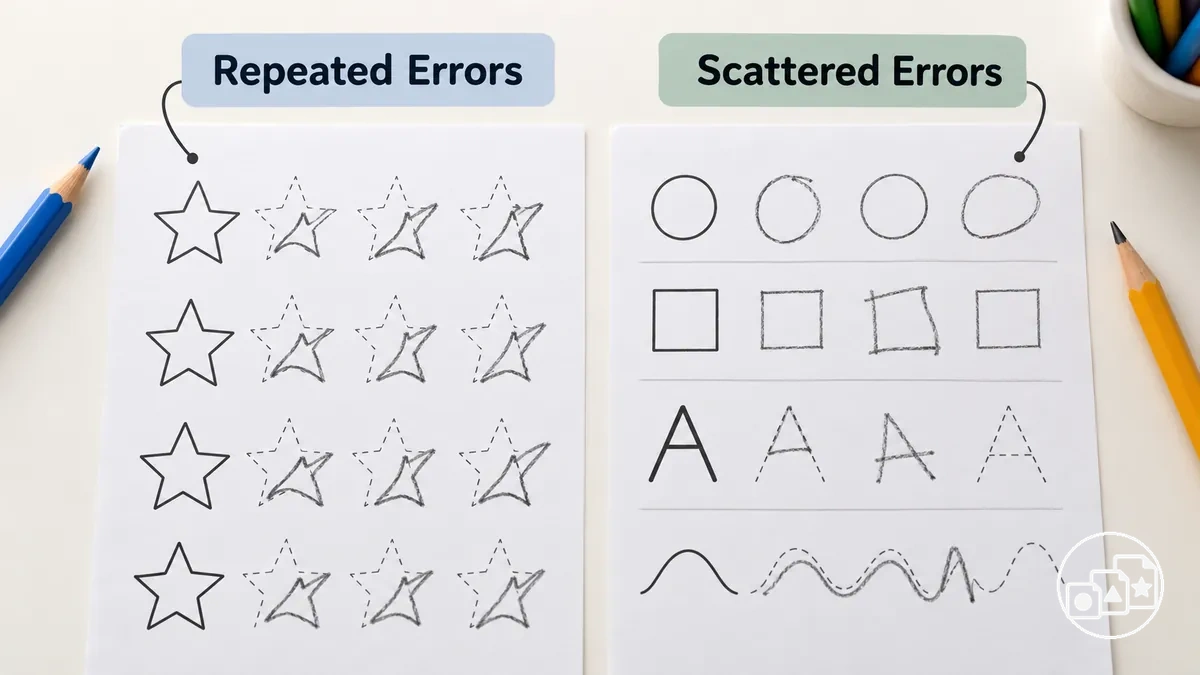
Look at error type, not just error count
Same error repeats on the same skill
A repeatable error pattern across similar items can make underlying skill difficulty more plausible, especially when it persists in other suitable formats.
Mistakes shift with task conditions
Scattered errors that change with rushing, unclear directions or inconsistent attention point more towards task or condition effects than one stable error pattern.
Clarification matters: a correction or self-correction after directions are clarified changes how the original mistake should be interpreted.
Avoidance or Needing Repeated Prompts
Worksheet avoidance or needing repeated prompts can signal that the task requires substantial effort, causes confusion or frustration, is poorly matched to the child, or is difficult to sustain.
The behaviour alone does not show which contributing condition is operating.
The worksheet avoidance and prompting pattern becomes more informative when it is considered alongside the task demand and the conditions under which the behaviour appears.

Two checks make avoidance more informative
- When does it start?
- Compare avoidance that begins as soon as pencil-and-paper work starts with avoidance that appears only after the worksheet becomes more demanding.
- What changes it?
- Notice whether performance improves when directions are clarified, the format is adjusted or one task demand is reduced.
Improvement after a change helps differentiate contributing conditions, but it does not establish a single cause.
Avoidance is an observable behaviour, not a diagnosis or proof of one cause.
More detailed worksheet refusal, rushing and focus patterns can be considered separately when the difficulty extends beyond this worksheet observation.
Common Causes of Kindergarten Readiness Worksheet Difficulty
Kindergarten readiness worksheet difficulty can arise through several mechanisms, and more than one contributing factor may affect performance at the same time.
A child's readiness state can interact with the task demand, worksheet format, output demands, and temporary conditions such as attention, fatigue, or frustration.
These conditions can affect accuracy, completion, consistency, or how independently the child works without establishing one cause from the visible performance alone.
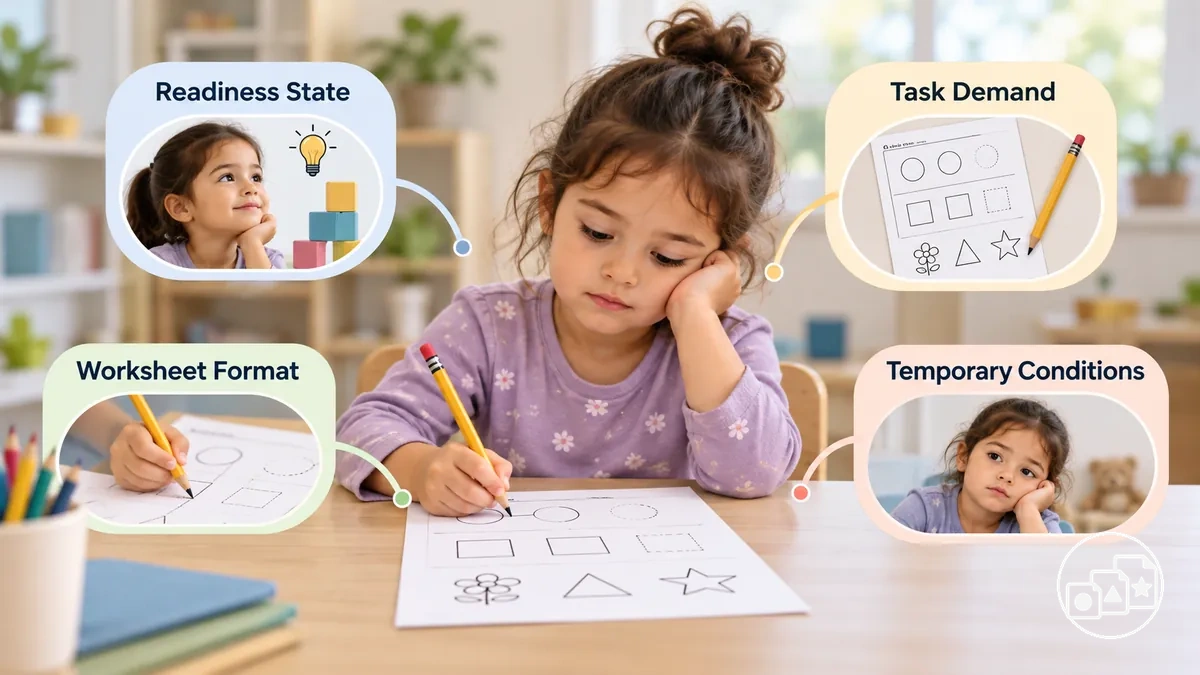
Five contributors can produce similar outward signs
Underlying readiness skill
If the target skill is not yet secure, the child may need more support and show reduced independence across suitable formats.
Task demand
Complexity, length, prerequisite skills or the number of steps can exceed what the child can manage reliably at that moment.
Worksheet format
Directions, visual load, symbols and layout can add demands beyond the skill being practised.
Output demand
Writing, tracing, copying or other pencil-and-paper demands can make it harder to show knowledge the child can demonstrate another way.
Temporary task conditions
Attention, fatigue, frustration, distraction or support can change performance even when the target skill stays the same.
These contributors can coexist. The same unfinished work, errors or prompting need can therefore arise through different mechanisms.
The Underlying Readiness Skill Is Not Yet Secure
An underlying readiness skill gap becomes more plausible when the same underlying concept remains difficult across more than one suitable way of demonstrating it.
Does the difficulty follow the skill or the format?
More consistent with an insecure skill
- The same concept remains difficult on a worksheet and in suitable oral or hands-on tasks.
- The pattern repeats across attempts despite suitable support.
- Transfer of the skill between formats remains limited.
Less consistent with a broad skill gap
- The child shows the concept more independently in another suitable format.
- Performance changes substantially with the response method or level of support.
- Difficulty is largely confined to one format or set of directions.
These observations can help identify possible kindergarten readiness skill gaps without treating a single worksheet result as proof of an underlying gap.
The Worksheet Demands More Than the Child's Current Skill Level
A mismatch becomes more plausible when the worksheet task demand exceeds the child's current skill level for reliable performance.
Test one task demand at a time
- 1Identify the added demand.
Look at prerequisite skill, item complexity, task length, number of steps, or how much independent responding is required.
- 2Reduce one demand while keeping the target skill the same.
For example, shorten a multi-step item without changing the concept being checked.
- 3Compare the result.
If performance improves, added task demand becomes more plausible; if difficulty remains, the underlying skill or another contributor still needs consideration.
Errors or unfinished work are more informative when they increase as task demand increases than when they are interpreted from one worksheet in isolation.
This distinction helps identify a possible mismatch without establishing a universal age cutoff; selecting or adapting worksheet difficulty and skill level belongs to the separate implementation context.
The Worksheet Format Adds Demands Beyond the Skill Being Practised
Worksheet format can add cognitive or procedural demands beyond the target skill being practised, so performance may change even when the child's underlying knowledge does not.
Layout, directions, visual scanning, symbols, and the response method can each introduce extra steps between understanding the target concept and showing it on the worksheet.
These format demands are relevant when they interfere with completing the task rather than simply reflecting a design preference.
Format demands to inspect
- A dense layout can increase visual scanning and make it easier for the child to lose their place.
- Multiple or unfamiliar directions can add steps to understanding what response is required.
- Greater visual scanning across separated items can make locating the relevant information harder while completing the task.
- Unfamiliar symbols can create uncertainty about what an item requires even when the target skill is understood.
- A response method that requires extra steps can affect performance without changing the child's understanding of the target skill.
The key distinction is whether difficulty follows the target skill or appears when the presentation format adds demands around it.
For example, a child who demonstrates the target concept in a simple format but makes errors when the same concept is presented with denser layout, unfamiliar symbols, or additional directions may be responding to the added format demand rather than the target skill alone.
The worksheet format can therefore contribute to difficulty without establishing that the underlying skill itself is insecure.
Pencil-and-Paper Demands Interfere With Showing the Underlying Skill
Pencil-and-paper output can interfere with showing target knowledge when pencil control, mark making, copying, or visual-motor coordination requires substantial effort to record an answer.
Keep the knowledge constant; change the response mode
Oral, pointing or hands-on response
If the child demonstrates the target knowledge accurately without writing, that provides evidence that the concept may be understood.
Writing, tracing or copying response
If performance drops mainly when pencil control, mark making, copying or visual-motor coordination is required, written-output effort may be contributing.
Persistent concerns across everyday writing or drawing tasks may warrant broader consideration, but worksheet performance alone cannot identify an underlying disorder.
Attention, Fatigue, or Frustration Makes Performance Inconsistent
Condition-sensitive worksheet performance can change between attempts when attention, fatigue, or frustration changes, even when the underlying skill has not changed.
The key attribute is consistency: performance that varies with temporary task conditions has a different implication from difficulty that remains stable across settings and response formats.
A repeated relationship between a particular condition and a change in performance is more informative than one unusually difficult attempt.
Look for a repeatable condition → performance relationship
- Duration or fatigue
- Accuracy, completion or persistence may fall as the activity continues, then recover after rest.
- Distraction or time of day
- Performance that repeatedly changes with environmental conditions suggests the condition is contributing.
- Frustration after repeated failure
- Later attempts may become less consistent even though the underlying target skill has not changed.
In contrast, difficulty that remains stable across both favourable and unfavourable conditions provides less evidence that temporary conditions alone explain the performance, and neither pattern by itself establishes ADHD, anxiety, low motivation, or another diagnosis.
How to Distinguish a Skill Gap From a Worksheet Mismatch
A skill gap is more plausible when repeated difficulty follows the same underlying skill across suitable formats, while a worksheet mismatch is more plausible when performance improves after the worksheet format or task demand changes.
Cross-format consistency therefore matters more than one difficult worksheet: difficulty that remains when the child shows the same skill in another suitable way points more towards underlying skill difficulty.
Improvement with a simpler presentation or a different output mode instead suggests that the original task may have added demands beyond the skill being checked.
Use a one-variable comparison
- 1Keep the target skill constant.
Use the same concept or learning goal so the comparison is about task conditions rather than a different skill.
- 2Change one factor.
Adjust format, visual load, number of steps, response mode, prompting or immediate task conditions.
- 3Repeat under comparable conditions.
A pattern that repeats carries more information than one unusually easy or difficult attempt.
- 4Interpret the direction of change.
Persistent cross-format difficulty makes an underlying skill issue more plausible; improvement after a specific task change makes a worksheet mismatch more plausible.
Mixed evidence should remain mixed: an emerging skill and a demanding worksheet format can affect the same performance at the same time. These comparisons organise observations; they do not establish a diagnosis.
Difficulty Across Different Task Formats May Point to a Skill Gap
A skill gap becomes more plausible when the same underlying skill remains difficult across multiple formats, including a worksheet, hands-on task, or oral response.
For example, if the target skill stays the same and the child has repeated difficulty demonstrating it in each of these suitable formats, the difficulty appears to follow the skill rather than one response format.
Cross-format difficulty is more informative when this pattern repeats, but it does not by itself establish a formal diagnosis.
What strengthens or weakens this interpretation?
Strengthens a possible skill-gap interpretation
- Difficulty persists despite suitable support.
- The same error pattern repeats across formats.
- Transfer of the skill remains limited.
- Independence stays low across suitable ways of responding.
Alternative explanations to check
- Insufficient prior instruction.
- Fatigue or other temporary task conditions.
- Unfamiliar directions affecting more than one format.
- Successful transfer or stronger independence in another suitable context.
The pattern can therefore support a cautious skill-gap interpretation without being treated as proof of a permanent deficit.
Difficulty Limited to One Worksheet Format May Point to Task Mismatch
A worksheet task mismatch becomes more plausible when the child can demonstrate the target skill in another suitable format but performance drops with a particular worksheet format or response method.
For example, a child may show the target skill successfully through an oral or hands-on response yet struggle when the same skill is presented on a worksheet with added visual or written demands.
This format-specific performance difference suggests that the difficulty may follow the task rather than the underlying skill, without showing that the worksheet is universally too difficult.
The useful distinction comes from identifying what changed while keeping the target skill constant.
Keep the target skill constant and inspect what changed
- Layout: denser or less familiar arrangement
- Directions: longer, unfamiliar or multi-part instructions
- Visual load: more items or scanning across separated information
- Steps: more actions required before the answer is complete
- Writing demand: tracing, copying or pencil control added to the task
- Item difficulty: greater complexity while the underlying learning goal remains comparable
If performance improves when one of these demands changes while the target skill remains the same, the interpretation shifts towards a possible task mismatch.
Changing one task demand at a time makes it clearer which worksheet attribute is associated with the performance difference without turning the observation into proof of a mismatch.
Variable Performance May Point to Attention or Task Conditions
Variable performance points more towards attention or task conditions when accuracy, persistence, or completion repeatedly changes with duration, distraction, fatigue, emotional state, or the level of support.
For example, a child may make more errors or stop sooner during a longer, distracting worksheet session but show recovery on a comparable task after rest or with fewer distractions.
A repeated relationship between the condition and the performance change is more informative than one inconsistent attempt, but condition-sensitive performance does not establish a specific cause.
Does performance follow the condition?
Performance changes with conditions
Recovery after rest, fewer distractions or improved support—while the skill demand stays comparable—makes temporary task conditions more plausible contributors.
Errors remain stable despite better conditions
Stable difficulty across favourable and unfavourable conditions provides less evidence that temporary conditions alone explain the pattern.
Occasional improvement does not rule out an underlying skill difficulty, and repeated variability does not by itself identify an attention-related condition.
Match the Next Step to the Cause of the Worksheet Struggle
The next step should match the most plausible cause of the worksheet struggle rather than the visible symptom alone.
A similar symptom, such as unfinished work or repeated errors, can reflect different causes and therefore call for a different check and corrective direction.
The decision flow below connects each established cause pattern with one proportionate follow-up check or adjustment; it organises possibilities rather than diagnosing the child.
Cause pattern → follow-up check → proportionate adjustment
- Underlying skill difficulty: If the likely cause is an insecure target skill, check whether the same difficulty persists across other suitable ways of demonstrating that skill. If it does, use focused skill support rather than repeatedly changing the worksheet.
- Excessive task demand: If performance falls as complexity, length, or the number of steps increases, check whether the child can demonstrate the same skill with a reduced task demand. If performance improves, use a more manageable demand while keeping the target skill intact.
- Worksheet format: If difficulty appears mainly with a particular layout, directions, or visual presentation, check performance with the same skill in a simpler format. If the difficulty reduces, simplify the relevant format demand without changing the skill being practised.
- Output burden: If pencil-and-paper responses interfere with performance, check whether the child can demonstrate the same knowledge through another suitable response method. If performance improves, reduce the immediate output burden while continuing to observe the underlying skill.
- Task conditions: If attention, fatigue, frustration, or other task conditions coincide with variable performance, check whether accuracy, persistence, or completion improves when those conditions change. If the pattern is repeatable, adjust the immediate task conditions rather than assuming the visible symptom has one fixed cause.
Each corrective direction should remain conditional, reversible, and proportionate to what the check shows.
A persistent concern or broader pattern that remains across suitable formats, levels of support and favourable task conditions may justify fuller assessment rather than repeated worksheet changes alone.