Troubleshooting Worksheet Refusal, Rushing and Focus in Kindergarten Readiness Practice
Refusal, rushing and loss of focus are different worksheet-engagement patterns. First identify what the child is doing, then change one task or practice-setup variable at a time and compare the response; re-engagement can show that an immediate condition mattered, but the behaviour alone does not establish a motive, diagnosis or cause.
Use the child’s observable response during the worksheet task as the starting point, then test one manageable change.
Worksheet troubleshooting at a glance
Match the observable pattern to the next useful check. The goal is to choose a response, not to label the child.
RefusalDoes not start, delays, or stops the worksheet task.
Check next
Clarify one next action or show a smaller, manageable part.
Use the response
If re-engagement improves, the immediate demand or setup may have been contributing. If distress continues, pause and reassess rather than increasing pressure.
RushingMoves quickly with skipped directions, omitted items or avoidable errors.
Check next
Check work quality, not speed alone, and use a brief check-before-finish routine.
Use the response
Fast, accurate and complete work does not itself need slowing. Adjust pace when speed is reducing accuracy, completeness or attention to directions.
Lost focusStarts, then repeatedly drifts away or needs prompting to return.
Check next
Change one controllable factor such as distraction, directions, visible workload or work-period demand.
Use the response
Improvement suggests that condition may have contributed in that session. Persistent difficulty across reasonable changes warrants broader observation, not an automatic diagnosis.
Shared rule: keep other immediate conditions as consistent as practical, change one variable, then compare what happens.
Worksheet engagement can change with task demand, timing and practice setup. A child may respond differently across worksheets, so treat each adjustment as a check of the immediate conditions rather than proof of a broader explanation.
Table of Contents⌄
Distinguishing Refusal, Rushing and Lost Focus During Worksheet Practice
Distinguish refusal, rushing and lost focus by what the child does during worksheet practice before inferring why it happens.
The observable signal—whether the child does not start or stops, completes work unusually quickly, or repeatedly drifts away—helps separate the patterns and determine what to check next.
Refusal is most directly observed when the child does not start or stops the worksheet task; rushing is more consistent with starting but moving rapidly through items, particularly when directions are skipped or avoidable errors appear; lost focus is more consistent with starting and then repeatedly drifting away and needing prompting to re-engage.
These signals can overlap, so one observation alone does not establish why the behaviour occurs.
The diagnostic flow organises each observable pattern by an immediate differentiating check and a cautious interpretation rather than treating the behaviour as a diagnosis.
Does not start or stops — refusal: Check whether a brief, neutral prompt or reset leads to re-engagement with the same worksheet task. Continued not starting or stopping supports refusal as the immediate engagement pattern, while re-engagement shows that the response can change after a prompt without establishing its cause.
Starts but moves too quickly — rushing: Check whether fast completion occurs with skipped directions, omitted items or avoidable errors. Rapid completion with these errors supports interpreting the observable pattern as rushing, while fast but careful and accurate completion provides less support for that interpretation.
Starts but repeatedly drifts away — lost focus: Check whether attention repeatedly moves away from the worksheet and whether prompting or a brief reset brings the child back to it. Repeated attention drift with a need for prompting supports lost focus as the immediate pattern, while re-engagement after a reset provides additional information without establishing why the drift occurred.
A brief reset or prompt can therefore add evidence to the interpretation without proving a cause.
Use the child's response after that check to refine the distinction and decide what needs checking next rather than assigning a motive from the observable behaviour alone.
Worksheet Refusal Is Not the Same as School Refusal
Worksheet refusal is task-specific: it refers to resisting, delaying, not starting or stopping a particular worksheet task during practice.
School refusal concerns avoidance of school attendance or broader school participation, so its scope, setting and context are different.
The image clarifies this distinction by separating the worksheet-task context from the broader school-attendance context.
For example, a child might delay starting a worksheet at home but still attend school and participate in other school activities; resisting that worksheet does not by itself establish school refusal.
The distinction is one of scope: worksheet refusal concerns a specific worksheet task, while school refusal concerns broader avoidance of school attendance or participation.
Checks That Separate Engagement Problems From Task Difficulty or Practice Setup
Before linking an engagement problem to a broader cause, check whether immediate task demand or practice setup may be contributing.
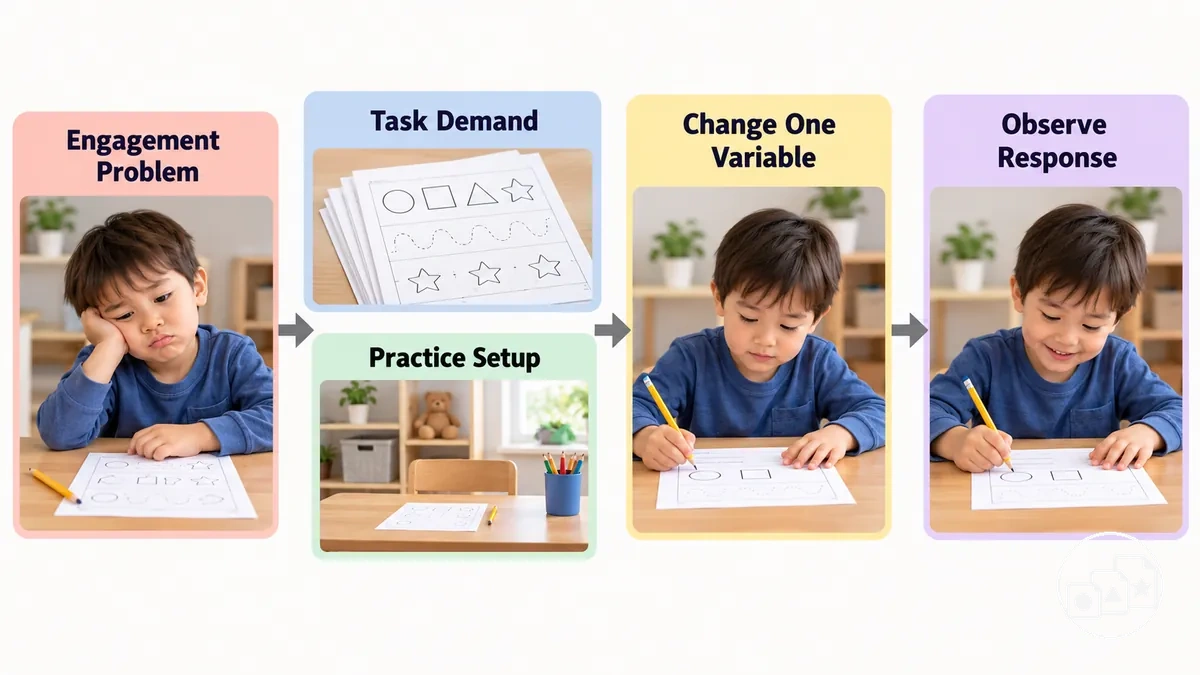
A useful diagnostic flow is to identify the observed behaviour, select one task or setup variable, change only that variable where practical, and compare the child's response; this order helps avoid jumping from a behaviour to an unsupported cause.
Identify the behaviour: Describe what happens during worksheet practice without assigning a cause.
Choose one variable: Select either a task-demand variable, such as worksheet difficulty or instructions, or a practice-setup variable, such as environment or timing.
Change one variable: Make one practical adjustment while keeping other immediate conditions as consistent as possible.
Compare the response: Observe whether engagement improves, remains similar or changes in another clear way after the adjustment.
If the behaviour persists after reasonable task and setup changes, the pattern deserves broader observation but still does not establish a cause by itself. For possibilities beyond the immediate task and setup check, see why children struggle with worksheets.
Check Whether the Worksheet Is Too Difficult or Too Demanding
A worksheet may be too demanding when the child repeatedly cannot understand or complete the task as presented, especially when the same skill becomes more manageable after simplification.
The check is whether worksheet difficulty and task demand appear mismatched with the child's current ability or stamina, not whether the child simply refuses or becomes frustrated.
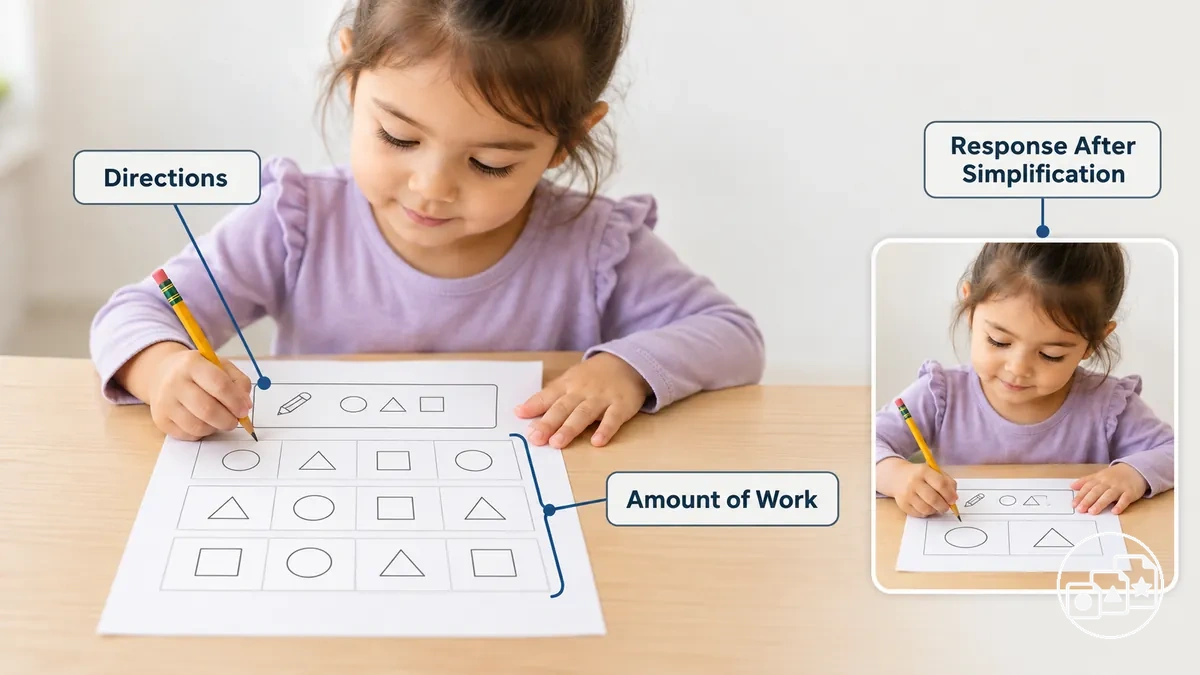
The annotated example highlights worksheet-demand features and the child's observable response without assigning an ability label.
Look for a pattern across observable indicators rather than treating any single behaviour as confirmation of a demand mismatch.
The criteria below distinguish difficulty with doing the task as presented from disengagement when the child can do it.
Directions: Repeated difficulty understanding what to do suggests checking whether the instructions themselves are adding to the task demand.
Errors on a familiar skill: Frequent errors when the underlying skill is otherwise familiar suggest checking whether the worksheet difficulty or presentation is making successful task completion harder.
Time and stamina: Taking unusually long to make progress on a small task, particularly with visible strain or declining persistence, suggests checking whether the amount of work exceeds the child's current stamina.
Simplified task: If the child performs the same skill more successfully when it is presented more simply, the improvement suggests that the original worksheet demand may have been too demanding under those conditions.
Ability versus disengagement: If the child cannot yet do the task as presented, a demand mismatch is more plausible; if the child can demonstrate the skill but disengages from the worksheet, difficulty alone is a less complete interpretation.
Practical demand states
Manageable
The child can understand and complete the task without recurring difficulty indicators.
Borderline
Difficulty indicators appear inconsistently, so compare the pattern across attempts and small adjustments.
Too demanding
Difficulty indicators recur and the same skill becomes more manageable when the task is simplified.
When the pattern suggests a likely mismatch, the detailed next step is to adapt worksheet difficulty. The immediate troubleshooting goal is to recognise a possible demand mismatch rather than treat errors, visible strain or disengagement as proof of insufficient skill.
Check Whether the Practice Setup Is Adding Distraction or Overwhelm
The worksheet practice setup can add distraction or overwhelm even when the worksheet content itself is manageable.
Check whether visible or controllable features of the immediate environment or presentation are associated with changes in the child's engagement during that practice session.
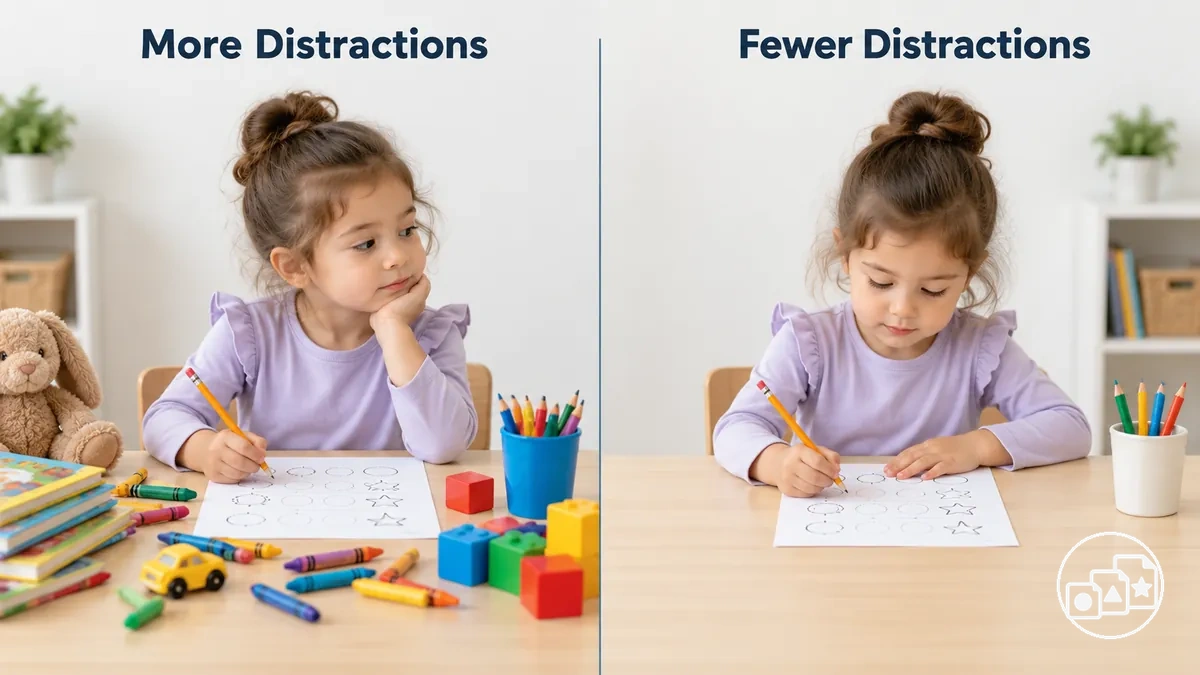
The comparison image shows differences between practice setups rather than differences in the child.
Scan the practice setup for conditions such as visual clutter, noise, several directions at once, an unclear stopping point, the amount visible, timing and seating.
These conditions may influence initiation, looking away, asking what to do next or the child's response to the amount of work shown.
The bullets pair each setup condition with one observable cue rather than treating the condition as a confirmed cause.
Visual clutter: Competing papers, toys or materials around the worksheet may contribute to distraction; check whether the child repeatedly looks away from the worksheet toward those items.
Noise or competing activity: Conversation, media or nearby activity may compete with the worksheet; check whether engagement changes when that competing stimulus is absent.
Directions: Several directions presented at once may add to the immediate load; check whether the child repeatedly asks what to do next or has difficulty initiating the task.
Stopping point: An unclear stopping point may make the amount expected difficult to judge; check whether the child repeatedly asks when the worksheet practice will finish.
Amount visible: A large amount of work visible at one time may contribute to overwhelm; check whether the child hesitates to begin or becomes distressed by the amount shown.
Timing and seating: The timing of practice or the work area's seating may affect engagement in that session; check whether the child's response changes when one of these conditions changes while the worksheet remains the same.
Responding to Worksheet Refusal, Frustration and Overwhelm
When refusal, frustration or overwhelm escalates during worksheet practice, reduce immediate pressure, clarify one manageable next action and reassess re-engagement rather than insisting on completion.
The immediate goal is to make the next check simpler while keeping the learning task available when continuing is appropriate.
Use this response sequence
Acknowledge: Name the observable refusal, frustration or overwhelm calmly without assigning blame or motive.
Reduce the immediate demand: Simplify what is being asked now so there is one smaller part of the worksheet to approach.
Clarify one next action: State one concrete action the child can take next, such as beginning the first available item rather than focusing on completing the whole worksheet.
Offer limited support or choice: Provide help with the next action or a small choice about how to approach it, while keeping the options clear and manageable.
Reassess: Observe whether the child can re-engage after the change. If engagement returns, continue from the simpler next action; if distress remains, pause rather than treating continued refusal as something that must be pushed through.
Break the Worksheet Into Smaller, Manageable Parts
Showing smaller parts of a worksheet can reduce the amount visible at one time, making the immediate task more manageable to approach.
This changes presentation and visible task size; it does not necessarily make the underlying skill easier.
For example, a full worksheet page can be covered so that only one row or one item group is visible, with a clear endpoint showing where the current part finishes.
Observe whether this smaller visible workload changes initiation or completion; if the child still resists, that response alone does not establish why.
Cover unused content: Hide the parts of the worksheet that are not part of the current task so the amount visible is limited to the immediate work.
Show one small target: Reveal one manageable row or one item group while keeping the underlying skill being practised the same.
Define the endpoint: Make the stopping point for the current part clear so the child can see what completion of that part means.
Complete the current part: Keep attention on the visible target and observe the child's response during initiation and completion.
Reveal the next part: After the current target is finished, uncover the next manageable portion and repeat the sequence as appropriate.
Helping a Child Slow Down on Worksheets
Slowing down is useful when rushing reduces accuracy, completeness or attention to directions, not simply because a child works quickly.
Speed is not the problem by itself
Fast and accurate
Directions are followed, required items are completed and work quality remains adequate. Fast completion alone does not require intervention.
Fast and error-prone
Directions are skipped, required markings or items are omitted, or avoidable errors increase. This is the pattern that warrants a pace-and-quality check.
Observable signs of rushing include skipped directions, incomplete work, avoidable errors, or handwriting and accuracy that deteriorate as the child moves through the worksheet.
These cues show when speed is affecting completion quality, but they do not establish why the child is rushing.
The goal of pacing support is accurate, complete work rather than an arbitrarily slow pace.
A timer or another pacing support may help in some situations, but its usefulness depends on the child's response; a simple self-check provides a direct way to see whether directions were followed and the current work was completed before moving on.
Clarify the expected pace: Ask for a pace that allows the child to follow the directions and complete the required work accurately rather than simply finishing quickly.
Work on a small amount: Present one manageable part at a time so the child can focus on completing that part before moving ahead.
Prompt attention to directions: Before starting the next part, have the child identify what the directions require rather than relying on speed or assumption.
Use a self-check: Before accepting the part as complete, ask the child to check for skipped directions, incomplete work and avoidable errors, then adjust the pace if those cues continue.
Build a Check-Before-Finish Routine
A check-before-finish routine turns the vague instruction to slow down into a few concrete actions a child can use before saying a worksheet is finished.
The self-check should focus on simple verification the child can perform, not on perfect work.
Keep the brief routine readable and repeatable: look again at the directions or model, confirm that the required items were attempted, and review one task-specific accuracy cue.
For example, on a simple matching worksheet, the child might check the model, see whether each required match was attempted, and review one pair for the expected mark or connection.
As the routine becomes familiar, reduce adult prompting so more of the verification is carried out by the child.
Check before saying “finished”
Look again: Check the directions or model before deciding the worksheet is finished.
Check attempted items: Confirm that each required item has been attempted rather than skipped.
Review one accuracy cue: Check one simple feature that fits the task, such as whether the mark, match, trace or response follows the model.
Correct if needed: Make a simple correction when the self-check reveals a missed item or obvious mismatch, then decide whether the work is finished.
Supporting Focus During Worksheet Practice
Focus during worksheet practice can change with immediate task and environmental conditions, so the first response should be to adjust those conditions and observe what happens rather than assume an attention disorder.
The practical aim is to support re-engagement by changing a modifiable part of the task or environment and watching the child's observable response.
The main levers are distraction, directions, clarity of the next action, the length or demand of the work period, and a brief reset when attention drops.
Each can affect how easily the child returns to the worksheet, but no single adjustment guarantees focus.
The bullets below link each modifiable condition to a practical support without ranking the conditions by importance.
Reduce distraction: Limit competing noise, movement or materials around the worksheet, then observe whether attention returns more easily to the task.
Simplify directions: Present the directions clearly and in a manageable form, then check whether the child can identify what to do without repeated prompting.
Clarify the next action: Make the immediate task explicit so the child knows what to do next rather than having to interpret the whole worksheet at once.
Keep the work period manageable: If attention fades as the session continues, shorten the immediate work period or reduce the amount tackled before checking whether focus improves.
Use a brief reset: When attention drops, pause or redirect briefly and then observe whether the child can re-engage with the worksheet.
Momentary distraction that improves after a simple adjustment suggests that the immediate condition may have been contributing during that session.
Repeated loss of focus across reasonable changes is a signal for broader observation, not a diagnosis. It does not by itself establish ADHD, anxiety or another condition; note which tasks and settings show the pattern and which adjustments change it.
Reduce Distractions and Keep Directions Brief
Reducing distraction in the immediate work area and shortening directions can lower the attention demands during worksheet practice.
Make one small change at a time so the child's response can show whether the adjustment makes the next action easier to follow.
The useful test is whether the child follows the next action more consistently after the change, rather than whether the work area becomes perfectly free of distraction.
For example, if several verbal directions lead to losing the sequence or repeatedly asking what comes next, give one immediate instruction, observe the response, and add the next instruction only after the first action is understood or demonstrated.
Remove competing materials: Move unrelated papers, toys or other competing materials away from the immediate work area to reduce visual distraction, then observe whether attention stays with the worksheet more consistently.
Show only the needed worksheet area: Cover or set aside parts that are not needed for the next action so the child has less competing worksheet information to attend to.
Shorten the directions: Give one or two instructions at a time when several directions are difficult to hold in sequence, then observe whether the child follows the next action with less prompting.
Ask the child to repeat: When appropriate, ask the child to repeat the next action in simple words so you can check whether the direction was understood before the child begins.
Ask the child to demonstrate: If repeating the direction is difficult or unnecessary, ask the child to demonstrate the next action, then use that observable response to decide whether another instruction is needed.
Use Short Work Periods and Breaks to Reset Attention
Fatigue or restlessness can provide an observable cue that the current work period is becoming harder to sustain, such as attention repeatedly drifting from the worksheet or productive work declining.
A brief movement break or quiet reset may help, but the useful test is what happens after the child resumes worksheet practice.
If re-engagement improves, the cycle may be useful under those conditions; if it does not, reconsider the current timing or break strategy rather than assuming a break will reset attention every time.
Work: Begin with a short work period that allows productive worksheet practice without using a fixed schedule as the target.
Notice: Observe attention for signs of fatigue or restlessness and use those cues to decide whether the current duration remains manageable.
Pause: Take a purposeful brief break when attention has deteriorated; for example, use a short movement or quiet reset without making a break the automatic response to every small challenge.
Resume and observe: Return to the worksheet and observe re-engagement. Adjust the next work period or break strategy according to whether productive attention returns.
When to Pause Worksheet Practice Instead of Pushing Through
Pause worksheet practice when distress, fatigue, inability to understand the task, loss of productive attention or unproductive conflict continues despite a simple adjustment or reasonable support.
A pause does not mean abandoning worksheets; it means that continuing in the same way is no longer the most useful immediate response.
The decision depends on what is happening now and how the child responds to support.
A manageable challenge that improves with help supports continuing, while repeated difficulty understanding the task suggests simplifying it.
Fatigue or attention loss may justify a break, while escalating distress or conflict that persists after a simple adjustment warrants stopping for now.
The decision flow separates a brief challenge worth supporting from a situation that merits pausing rather than applying a rigid pass-or-fail rule.
Choose the next step from the current response
Continue with support
If the child remains able to engage and the challenge becomes manageable with brief help, continue while observing whether productive attention is maintained.
Simplify
If the child repeatedly cannot understand the task as presented, simplify the immediate task and observe whether it becomes manageable.
Take a short break
If fatigue, restlessness or loss of productive attention is increasing, pause briefly and reassess after the child returns rather than assuming the worksheet must end.
Stop for now or reconsider the practice mode
If distress or conflict continues to intensify, or productive engagement does not return despite reasonable adjustments, stop the worksheet for now and reconsider how the skill is being practised.
A one-off difficult session may simply need rest or a different practice mode and does not by itself require broader investigation.
If the same difficulty repeatedly persists across suitable tasks and settings despite appropriate adjustments, broader observation may be useful. When worksheet practice remains unproductive, worksheets and hands-on learning explains when to consider a different way to practise the skill.