
Number Recognition and Counting Skills for Kindergarten Readiness
Kindergarten number readiness is best understood as a profile of connected skills, not one counting target. Look for numeral recognition, a stable number-word sequence, accurate one-to-one object counting, and understanding that the final count represents the total; these abilities can develop unevenly, so counting farther by rote does not by itself show quantity understanding.
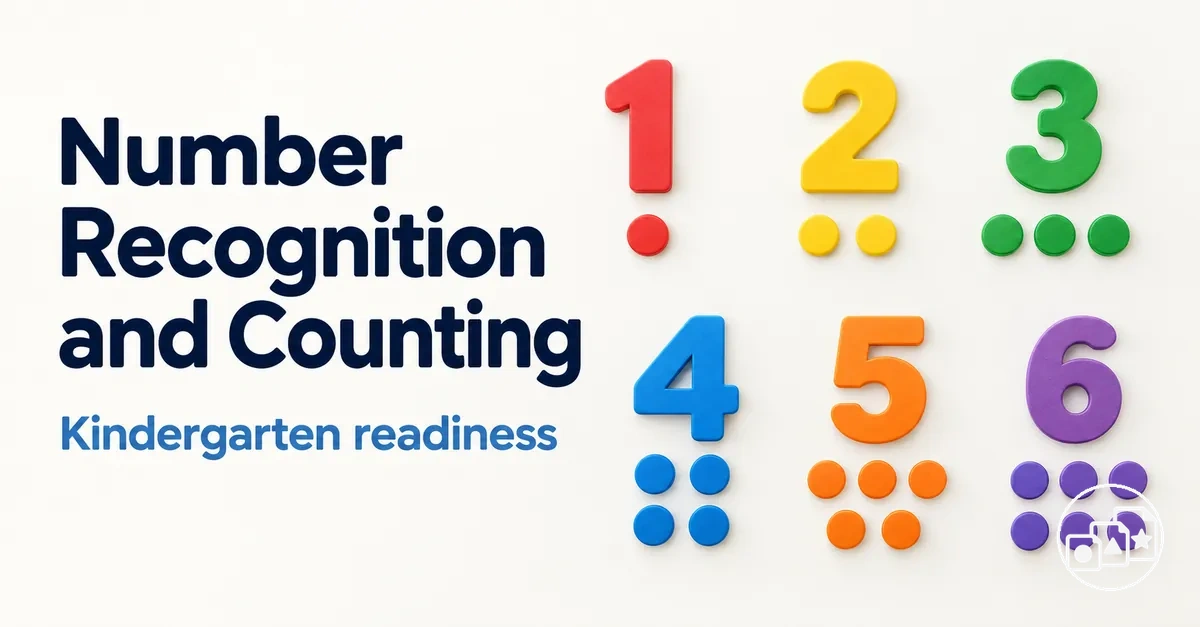
Number readiness at a glance
Use these connected abilities together when observing early number knowledge. Each one answers a different question about what a child can recognise, say, coordinate or understand.
- Numeral recognition
- written symbol → number name → represented quantity The child identifies a numeral without needing to count up from one.
- Stable number sequence
- number words → conventional order The spoken sequence stays in the same correct order rather than changing unpredictably.
- One-to-one object counting
- one object ↔ one count word Each object receives one count, with no items skipped or counted twice.
- Cardinality
- final count → total quantity After an accurate count, the last number word answers “how many?” for the whole set.
- Small-quantity recognition
- visible small set → amount Some small sets can be recognised at a glance without counting each item; arrangement and set size can affect this.
Counting range is not a universal pass/fail cutoff. Keep verbal counting, numeral recognition, object-counting accuracy and quantity understanding separate when deciding what a child is ready to practise next.
These skills can develop at different rates, and readiness expectations vary by setting and stage; use several observable number behaviours together rather than one recitation range.
Table of Contents
How Number Recognition and Counting Differ
Number recognition and counting are both early numeracy skills, but they demonstrate different knowledge.
Number recognition involves identifying a written numeral and connecting it with a number name or quantity.
Counting involves producing an ordered counting sequence and, during object counting, coordinating number words with objects.
The distinction becomes clearer when both skills are compared by the task performed, the knowledge demonstrated, and the behaviour that can be observed.
The visual contrast separates identifying a numeral from counting objects, while the comparison table applies the same criteria to both skills.
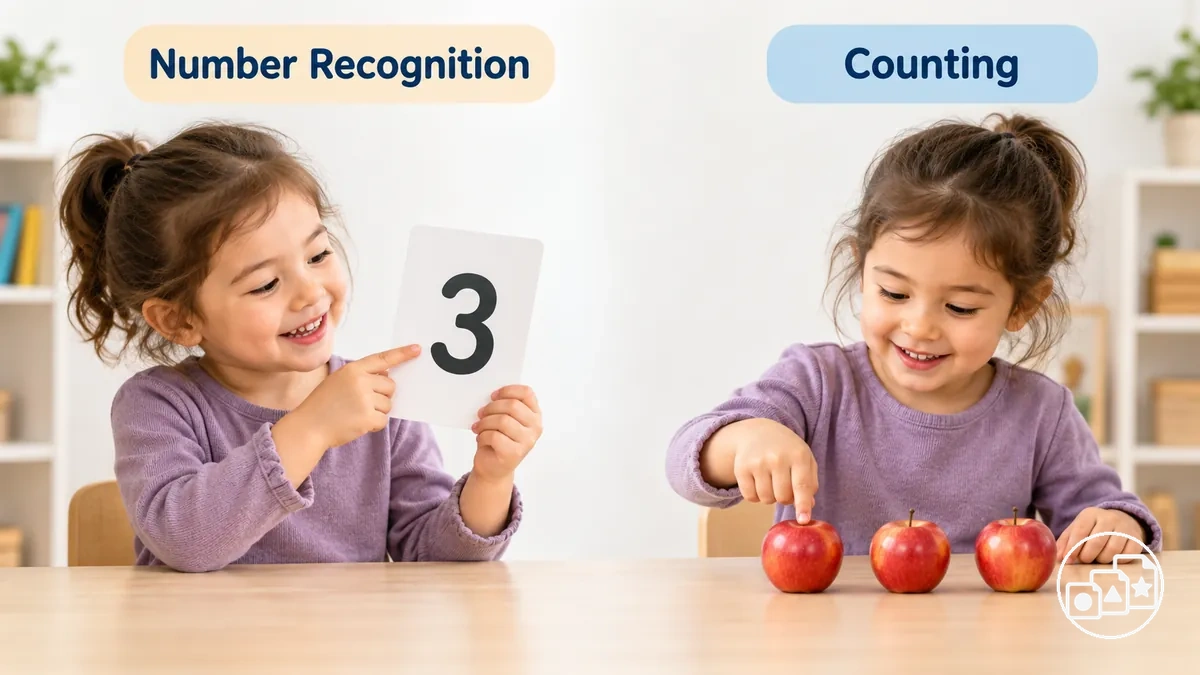
| Skill | Core task | What it demonstrates | Observable example |
|---|---|---|---|
| Number recognition | Identify a written numeral and connect it with its number name or quantity. | Knowledge of numeral symbols and what they represent. | A child sees a written numeral and says its number name without reciting the counting sequence to reach it. |
| Counting | Produce number words in order and, for object counting, coordinate one count with each object. | Knowledge of the counting sequence and, when counting objects, one-to-one correspondence between number words and items. | A child counts a small set by assigning one number word to each object and identifies the resulting total as the quantity counted. |
The two skills can develop unevenly, so strength in one does not establish the same level of skill in the other.
For example, a child may recite number words in the correct order but be unable to identify one of those numerals when written, or may recognise a numeral but miscount a set of objects.
Either skill can be stronger than the other without that single observation determining overall kindergarten readiness.
Number Recognition Skills That Support Kindergarten Readiness
Number recognition involves identifying a written numeral and understanding that the symbol represents a particular number; functional recognition also connects the numeral with its spoken number name and the quantity it can represent.
Independent recognition adds a separate attribute: the child identifies the written number without relying on its position in a counting sequence. Keeping these connections separate helps distinguish visual identification from symbol-to-name and symbol-to-quantity knowledge.
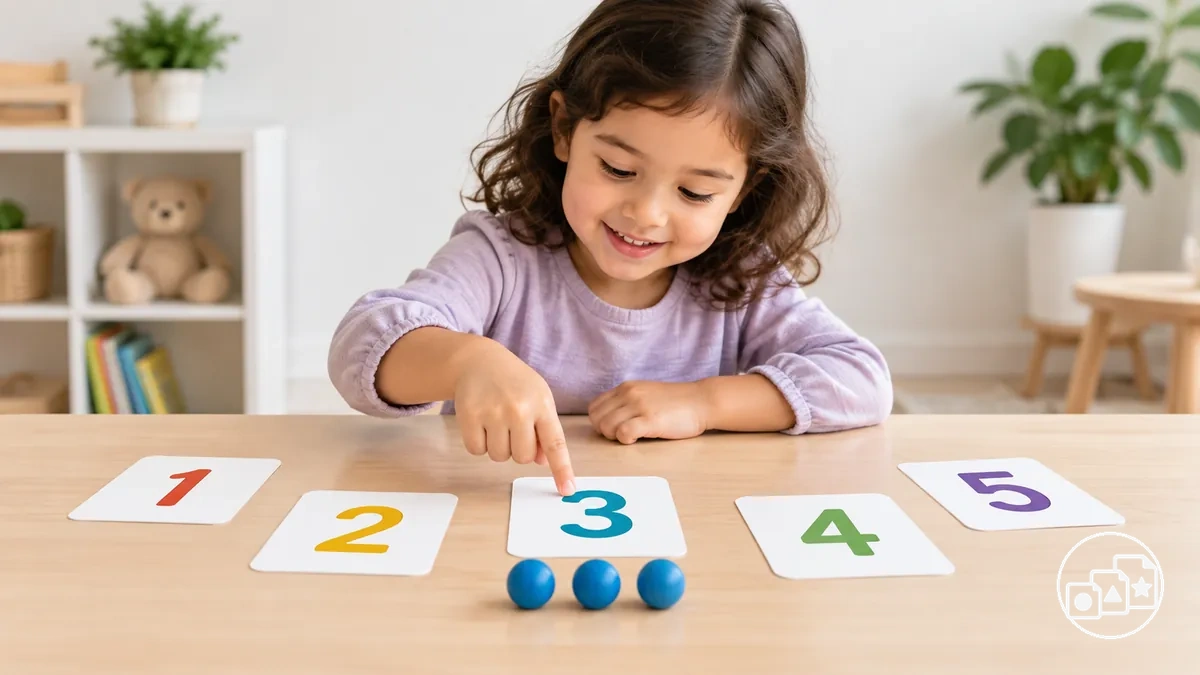
What functional numeral recognition includes
- Recognise the numeral: visually identify the written symbol as a particular numeral rather than treating it as an unfamiliar mark.
- Name the numeral: connect the written numeral with the corresponding spoken number name.
- Connect the numeral to a quantity: relate the symbol to the amount represented by a matching set.
- Recognise it independently: identify the numeral without working through the counting order to determine which number it is.
For example, if a child sees the numeral 4 and identifies it as “four” without reciting “one, two, three, four” first, the behaviour illustrates independent recognition rather than sequence-dependent identification.
Connecting that numeral with a set of four objects can also show an association between the written number and its represented quantity, although one successful example alone does not establish broader number understanding.
Recognising Numerals Independently of Counting Order
Independent numeral recognition means being able to identify a written number without reciting a counting sequence from one.
Immediate recognition occurs when the numeral is recognised directly as a written symbol.
It does not depend on using counting order to work forward until the target number is reached.
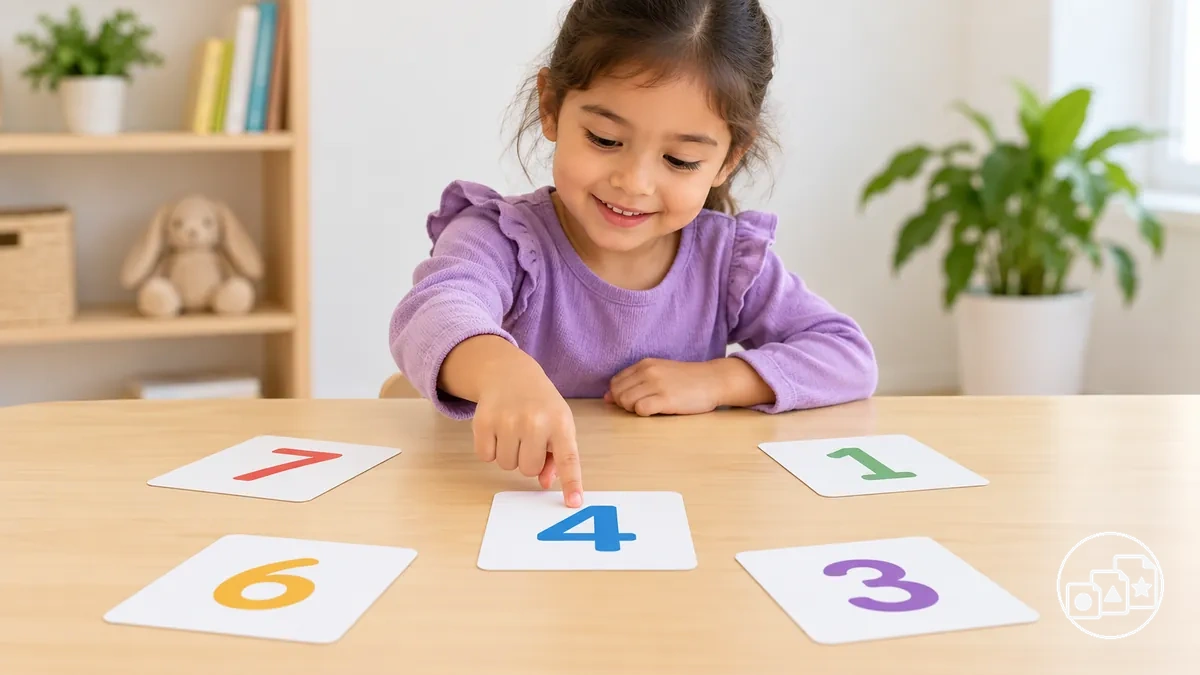
Independent recognition
See 7 → say “seven” directly.
This demonstrates immediate recognition of the written numeral.
Sequence-dependent identification
See 7 → recite “one, two, three, four, five, six, seven” → identify it.
The correct sequence shows counting-order knowledge, but not independent recognition of the numeral.
Immediate identification suggests more direct symbol knowledge, while hesitation or reliance on the sequence in a single observation does not establish a broader difficulty.
Connecting Numeral Symbols With Number Names and Quantities
A numeral symbol is the written form used to represent a number, while the number name is its spoken label and a quantity is the amount it represents.
Connecting these forms links the written numeral with its verbal form and a represented set.
The same number can therefore be represented symbolically, verbally, and quantitatively.
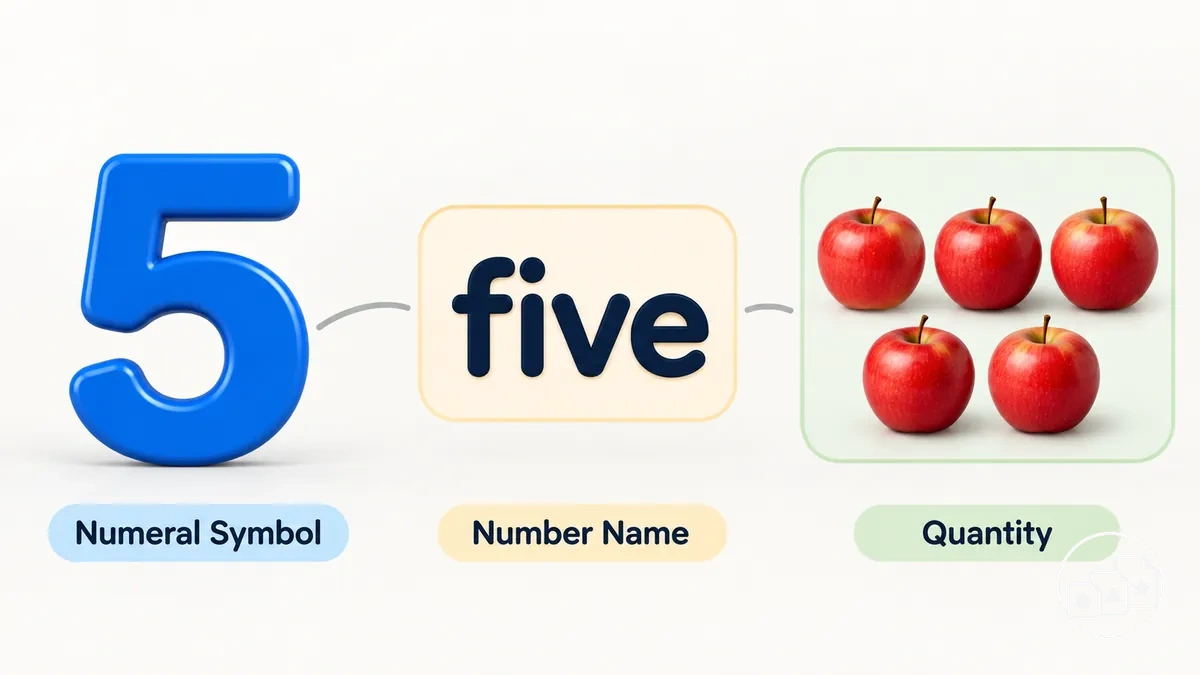
5
the written numeral
five
the spoken label
● ● ● ● ●
a set containing five objects
Identifying 5 as “five” shows the symbol-to-name connection; matching both with five objects adds the represented amount.
Naming a numeral does not by itself show that the amount it represents is understood.
A successful match between one numeral, its number name, and its quantity indicates that connection for that example, but it does not establish the same understanding across all numerals or representations.
Counting and Quantity Skills That Support Kindergarten Readiness
Counting and quantity skills involve more than reciting a number sequence from memory. Meaningful counting combines stable number-word order with one-to-one coordination of words and objects, then connects the count to the quantity represented.
Stable order, one-to-one correspondence, cardinality and small-quantity recognition describe different parts of that progression from verbal sequence knowledge to coordinated object counting and understanding of amount.
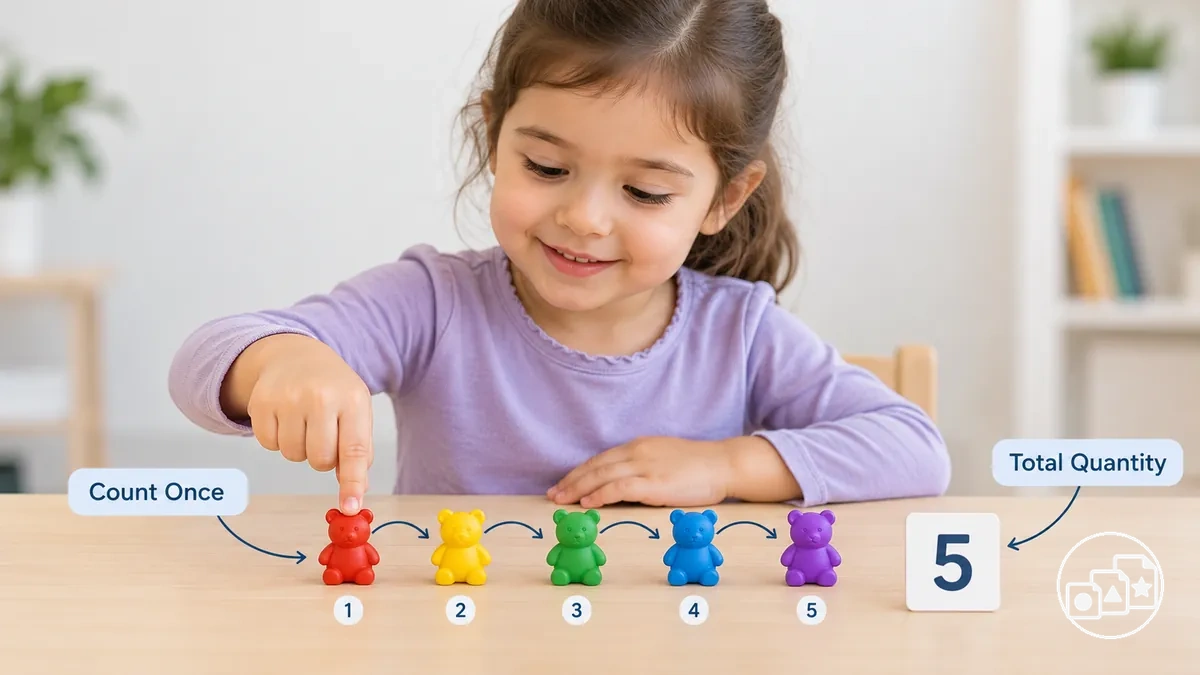
Four connected counting and quantity abilities
- Stable order: number words remain in a consistent counting sequence, supporting accurate progression from one number word to the next.
- One-to-one correspondence: each object receives one count during object counting, supporting coordination between the spoken count and the objects being tracked.
- Cardinality: the final number word used when a set is counted represents the total quantity in that set.
- Small-quantity recognition: some small quantities can be recognised as an amount without counting each object individually, a process commonly described as subitising.
During object counting, these abilities can work together: a child may say number words in stable order, point to each object once and then use the final count to state how many objects are in the set. Recognising a small quantity at a glance provides another route from a visible set to its amount.
One observation does not establish the same level of understanding across every set or counting situation.
Counting and quantity abilities are one subset of broader kindergarten readiness skills.
Their relevance lies in showing how number-word knowledge can connect with objects and quantities without treating any single counting behaviour as a universal readiness standard.
Saying Number Words in a Stable Sequence
A stable number-word sequence means saying number words in a consistent conventional order during verbal counting.
The sequence follows the same order each time rather than changing unpredictably.
This stable order provides a verbal foundation that can later be coordinated with objects during object counting.
Stable order
one, two, three, four, five
The conventional order is maintained.
Omission
one, two, four, five
“Three” is skipped.
Reversal
one, two, four, three, five
Part of the conventional order is reversed.
An occasional omission or reversal shows an inconsistency in that instance; one mistake does not establish a persistent developmental issue.
A stable sequence demonstrates verbal counting knowledge rather than, by itself, quantity understanding.
Using One-to-One Correspondence to Count Each Object Once
One-to-one correspondence in object counting means assigning one number word to each object and counting each object once.
Each spoken count matches one item in the object set.
This coordination supports count accuracy by keeping objects and count words matched one to one.
- Each object counted once
- Each item receives one number word; in a set of five items, all five objects are matched to one count each.
- An object is skipped
- That item receives no count word, so the resulting count can be too low.
- An object is counted twice
- The same item receives more than one count word, so the resulting count can be too high.
A skip or double-count is an observable error in that counting attempt; one instance does not by itself confirm a developmental problem.
Understanding That the Final Count Represents the Total Quantity
Cardinality means that, when an object set has been counted accurately, the final number word represents the total quantity in the set.
The final count therefore answers the question “how many?” for the whole set.
This gives the counting sequence quantity meaning rather than leaving it as verbal recitation alone.
Final count used as total
Count five objects → asked “how many?” → answer “five”.
This shows the last number word being used as the total amount.
Immediate recount
Count the set → asked “how many?” → count the same objects again.
This may suggest that the last count is not yet being used consistently as the total.
The key distinction is whether the final count represents the quantity of the whole set. Recounting once does not by itself establish a broader difficulty.
Recognising Small Quantities Without Counting
Recognition of small quantities means being able to recognise at a glance how many items are present in a small set without counting each item individually.
This immediate quantity recognition is commonly described as subitising.
Immediate quantity recognition
See three dots and recognise “three” without deliberately counting each dot.
Deliberate object counting
A larger or less familiar arrangement may lead the child to count the items one by one.
Both behaviours can contribute to quantity sense. The range that can be recognised immediately varies with factors such as set size and visual arrangement, so it should not be treated as a rigid readiness threshold.
What Counting Range Means for Kindergarten Readiness
The highest number a child can recite describes verbal counting range, but it is only one part of early number performance and is not a universal standalone readiness threshold.
Recitation does not show whether the same range can be recognised as written numerals, counted accurately as objects or understood as quantities. For that reason, keep verbal counting, numeral recognition, object counting and quantity understanding as separate demonstrated ranges.
Four different ranges to keep separate
- Verbal counting range: how far a child can produce number words in sequence demonstrates recitation knowledge, but a longer memorised sequence does not by itself show accurate object counting or quantity understanding.
- Numeral recognition range: the written numbers a child can identify demonstrate the range of numeral symbols connected with their number names, which may differ from the verbal counting range.
- Object-counting range: the size of a countable set a child can count accurately demonstrates coordination of the counting sequence with one-to-one correspondence; a shorter accurate object count can therefore reveal knowledge that a much longer memorised sequence does not.
- Quantity understanding: interpreting a count as the total amount demonstrates that number words and counted sets carry quantity meaning rather than functioning only as a recited sequence.
Readiness expectations can refer to different skills, educational settings and developmental stages, so expectations for entry to kindergarten should not be confused with standards intended for later in the kindergarten year. Some guidance uses ranges such as 10 or 20, while other guidance describes broader abilities such as recognising numerals and counting objects rather than one universal recitation target.
When recognition, recitation, object counting, and quantity understanding are uneven, a broader look across those skills can help find readiness skill gaps without treating one counting range as a formal readiness verdict.
The demonstrated range for each skill can also indicate which number tasks are currently accessible and which would add difficulty.
Considering that demonstrated skill range can help choose an appropriate worksheet level while keeping task difficulty separate from a universal kindergarten readiness cutoff.
No single counting range should therefore be applied as a mandatory benchmark across different settings and stages.
Why Counting Farther Is Not the Same as Understanding Quantity
Counting farther in a verbal sequence demonstrates how far a child can produce a memorised recitation, but it does not necessarily demonstrate quantity understanding.
Rote counting relies on sequence memory, whereas quantity understanding involves interpreting a number as an amount or total.
A child can therefore recite a long sequence while still having difficulty with object counting or connecting a numeral with the quantity it represents.
Longer verbal range
Recites to 20, but miscounts six objects or is unsure what quantity the numeral 6 represents.
Shows a longer memorised number-word sequence.
Quantity meaning within a smaller range
Recites to 10, accurately counts six objects and identifies six as the total.
Shows quantity meaning within the demonstrated range.
Rote counting still shows useful knowledge of number-word order, but verbal range and quantity understanding are different attributes. One scenario does not by itself establish a broader learning difficulty.
Why Counting Objects Reveals More Than Memorised Recitation
Object counting reveals how stable number-word order, one-to-one correspondence, object tracking and interpretation of the final count work together in a way that memorised recitation alone cannot show.
These observable behaviours provide information about count coordination as well as sequence knowledge.
What object counting lets you observe
- Stable number-word order: using number words in their conventional sequence while counting objects shows that the verbal sequence remains coordinated with the counting task.
- One-to-one correspondence: assigning one number word to each object shows whether each item receives one count rather than being missed or counted more than once.
- Object tracking: keeping track of which objects have already been counted helps prevent skipping and double-counting, supporting an accurate result for the set.
- Final count: using the last number word to answer how many objects are present shows that the final count is being interpreted as the total quantity rather than only as the end of a recited sequence.
For example, while counting a small set, a child might maintain stable number-word order but skip one object, double-count another, or begin recounting when asked for the total.
Those behaviours can draw attention respectively to object tracking, one-to-one coordination, or interpretation of the final count, depending on what occurred during the count.
The observation describes which part of object counting may need closer attention; one instance does not by itself establish a broader difficulty or formal diagnosis.