
Letter Recognition for Kindergarten Readiness
Letter recognition for kindergarten readiness is the ability to identify a printed letter from its visual form and give its letter name. Readiness is best judged from a pattern of recognition across uppercase and lowercase forms, repeated and random-order checks, and increasingly independent responses; letter-sound knowledge is related but separate, and no single letter count is a universal kindergarten-entry threshold.
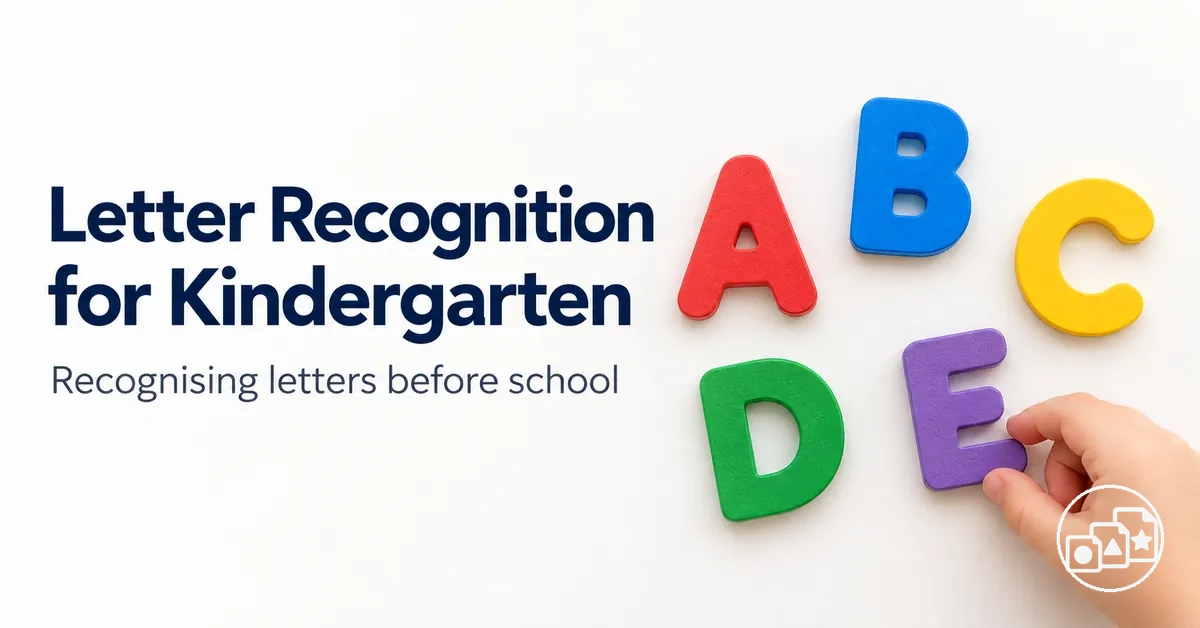
Letter recognition readiness at a glance
Look for the pattern across these observations rather than treating one result as a pass-or-fail score.
- Printed letter → name
- The child identifies the letter that is shown instead of relying on the next item in a memorised alphabet sequence.
- Uppercase + lowercase
- Check case forms separately and whether corresponding forms, such as A/a, are recognised as the same letter identity.
- Repeated + random order
- The same familiar letters are identified across repeated checks when their order or surrounding letters change.
- Less cueing
- Recognition becomes more independent when hints, alphabet-order cues and repeated prompts are reduced.
Keep separate: naming a printed letter is letter recognition; producing or recognising its associated sound is letter-sound knowledge.
Use the pattern to choose practice: revisit the letters or forms that remain unstable. A letter count can describe performance, but it is not a universal kindergarten-entry threshold or a diagnosis.
Table of Contents
What Letter Recognition Includes Before Kindergarten
Letter recognition includes being able to identify a displayed letter by its letter name and visual shape, recognise its uppercase and lowercase forms, and match case forms that represent the same letter.
Consistency is shown when a child identifies the displayed letter from its visual form rather than relying on alphabet order or another cue.
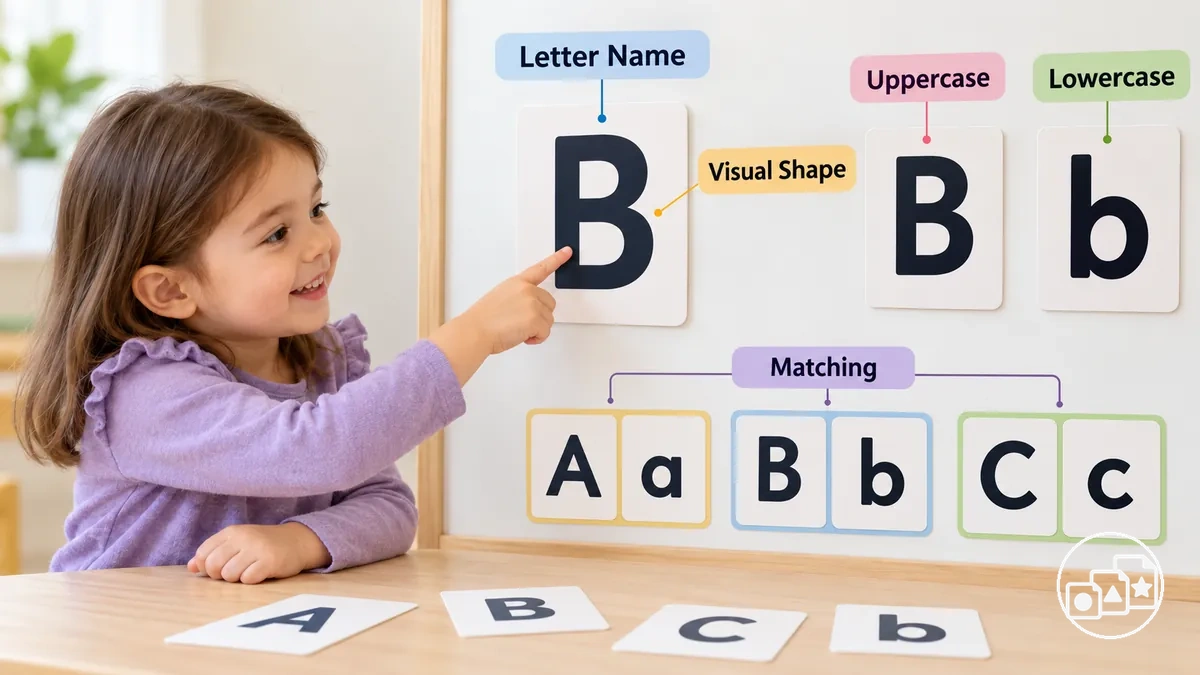
What to observe
- Letter name: identify the name of a displayed letter rather than supplying the next letter from alphabet recitation.
- Visual shape: distinguish a printed letter from other letter shapes when it is presented visually.
- Uppercase and lowercase: recognise both uppercase and lowercase case forms as representations of letters, including forms whose visual shapes differ.
- Matching: match an uppercase form with the lowercase form representing the same letter.
- Consistency: recognise familiar letters when prompts, presentation, or order change, rather than identifying them only within a memorised alphabet sequence.
Alphabet recitation shows recall of a learned sequence, whereas letter recognition requires identifying the printed letter that is presented.
Letter recognition is one readiness area among several; the kindergarten readiness skills checklist provides the neighbouring broader readiness context.
Recognising Letters by Name and Shape
Recognising an individual letter by name and shape starts with seeing a printed symbol, distinguishing its visual features, and retrieving the corresponding letter name.
Recognition is demonstrated when the child can identify and name the printed symbol from its visual form, rather than infer the answer from alphabet order.
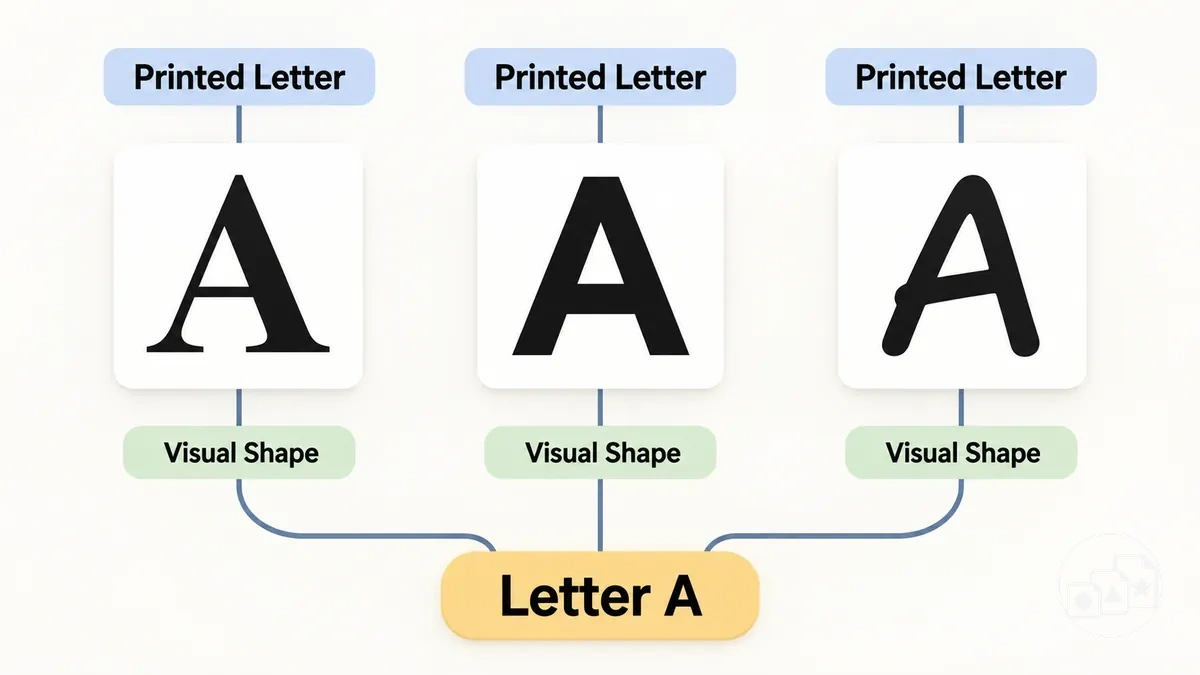
Naming a displayed individual letter differs from reciting a memorised alphabet sequence because recitation does not require visual identification of the symbol being named.
For example, if the letter A appears in different ordinary print contexts, recognising each displayed form as the letter name “A” demonstrates the visual-form-to-name relationship.
Recognising Uppercase and Lowercase Letters
Uppercase letters and lowercase letters are related letter forms of the same alphabetic identity, but a child may recognise each visual form with different consistency.
Recognising an uppercase form therefore does not by itself show that the corresponding lowercase form is also recognised.
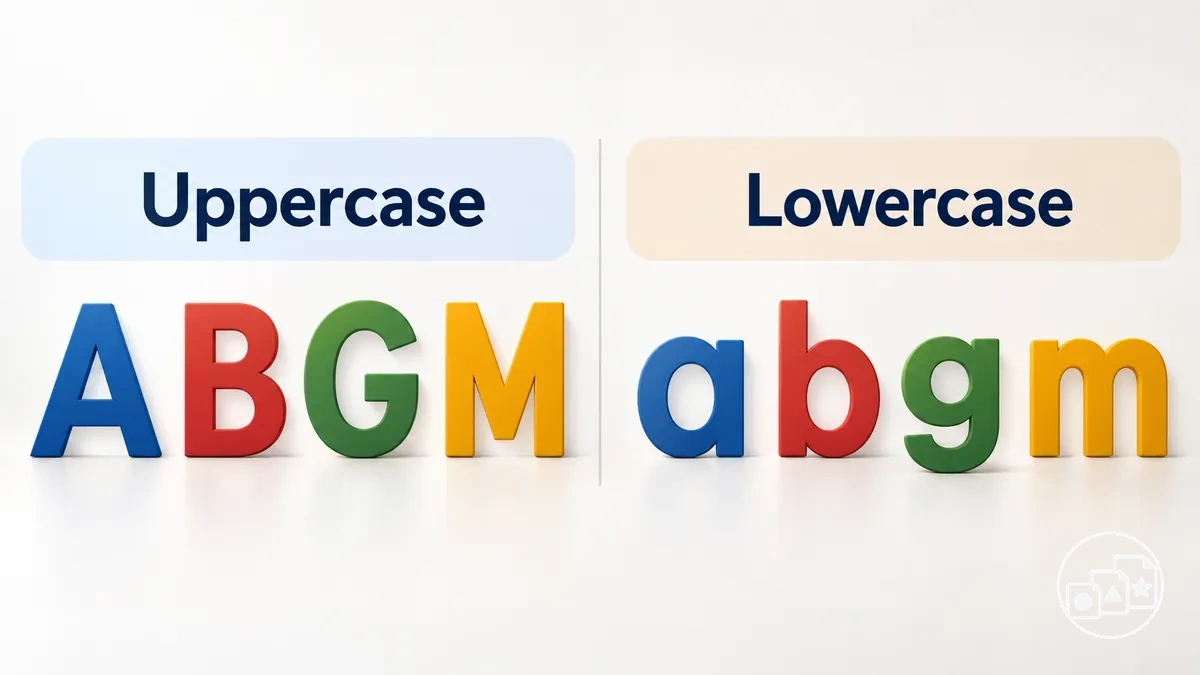
Case-specific recognition is shown by whether the child can identify the printed letter when that particular case form is presented.
For example, a child who consistently recognises uppercase A may not yet consistently recognise lowercase a, even though both represent the same letter identity.
Matching Uppercase and Lowercase Letter Forms
Matching links an uppercase form to its lowercase counterpart by recognising that both represent the same letter identity despite a visual difference.
The task is to connect equivalent letter forms, not to demonstrate handwriting ability.
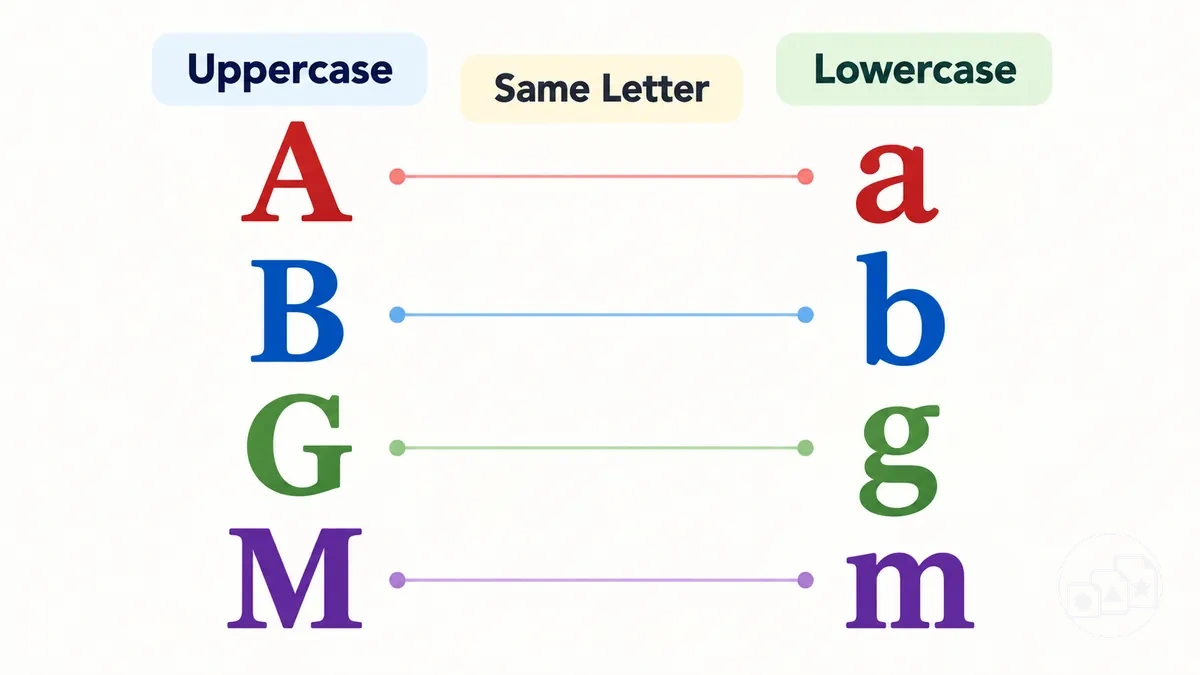
Recognising a form means identifying it when it is shown, while matching the counterpart requires comparing two case forms and selecting the pair that represents the same letter.
For example, A pairs with a, B with b, and G with g; the case shapes may look similar or noticeably different while retaining the same letter identity.
Letter Recognition and Letter-Sound Knowledge Are Different Skills
Letter recognition and letter-sound knowledge use the same alphabet context but require different responses: name the printed letter versus produce or recognise its associated sound.
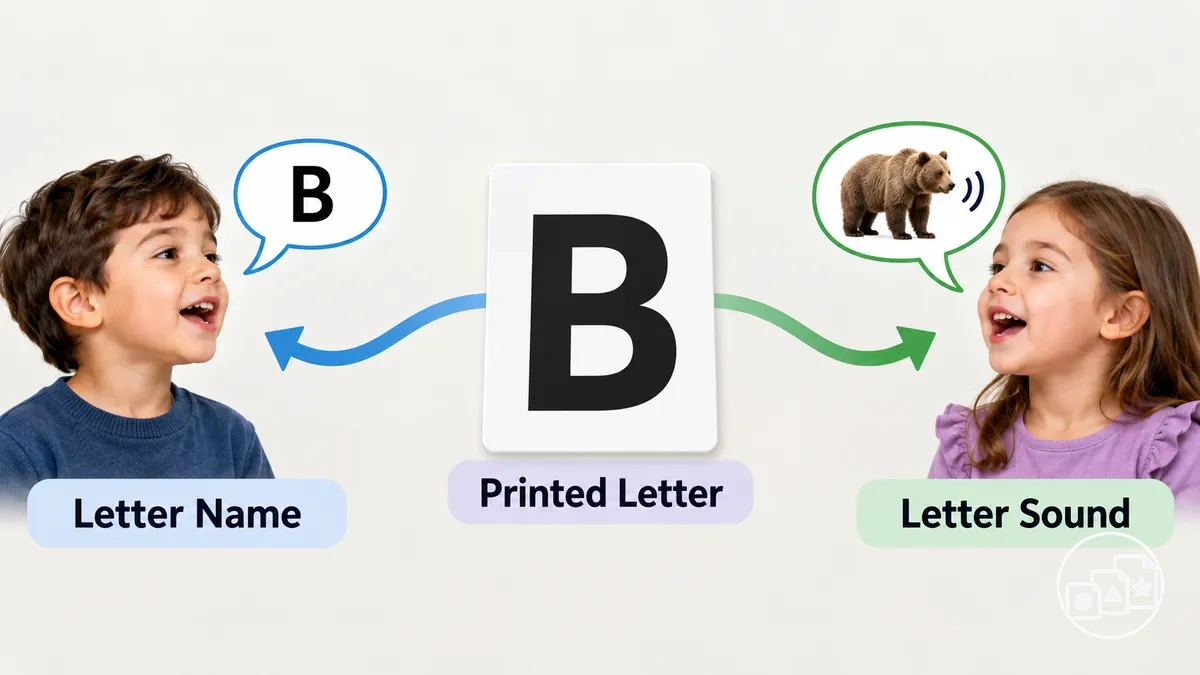
Compare the prompt, expected response and interpretation to keep the two skills separate.
| Skill | Prompt | Expected Response | What Success Shows |
|---|---|---|---|
| Letter recognition | Show a printed letter and ask which letter it is. | Provide the letter name. | The child can identify the printed letter by name. |
| Letter-sound knowledge | Show a printed letter and ask for or present its associated sound. | Produce or recognise the corresponding letter sound. | The child associates the printed letter with a spoken sound. |
For example, a child may correctly name a printed B while not yet recalling its associated sound, so success on the naming prompt does not by itself demonstrate sound knowledge.
The skills remain related within the alphabetic principle and the broader development of pre-reading and early literacy, even though they are distinct assessment targets.
What Letter Recognition Readiness Looks Like Before Kindergarten
Letter-recognition readiness is better interpreted through a pattern of consistent recognition than through one universal cutoff.
Observable readiness is more informative when a child can identify letters across case forms and changing presentation conditions with an increasingly independent response.
Use the criteria together: case coverage shows breadth, while repeated random-order checks and reduced prompting show whether recognition is stable and less cue-dependent.
Readiness signals to combine
- Consistent recognition: identifying the same familiar letters across repeated checks suggests more reliable recognition than identifying them only intermittently.
- Uppercase coverage: recognising uppercase forms across the child's developing letter knowledge provides evidence for that case, but should be considered alongside lowercase coverage.
- Lowercase coverage: recognising lowercase forms broadens the recognition pattern beyond uppercase letters and can reveal case forms that still need practice.
- Random order: identifying letters when they appear outside alphabetical order suggests the response is based on the displayed letter rather than reliance on the memorised alphabet sequence.
- Independent response: identifying a printed letter without hints, surrounding alphabet cues, or repeated prompts indicates recognition that is less cue-dependent; needing those supports points to a practice need rather than a pass-fail result.
Letter counts, ages and percentages can be useful only within a defined assessment context; none should be treated as a universal kindergarten-entry threshold.
Checking Consistent Letter Recognition in Random Order
Presenting letters in random order helps distinguish independent visual identification from sequence memory because the child cannot rely on familiar alphabet order as a cue.
A consistent name response to a presented letter when letters are shuffled supports recognition that persists when sequence cues are removed.
Use this as an informal consistency check, not a diagnostic assessment; repeated responses are more informative than one isolated miss.
Consistency check
- Present letters in random order: shuffle familiar letters rather than presenting them alphabetically so sequence memory provides less support.
- Ask for the presented letter's name: observe whether the child can identify the letter without an added cue; keep letter-sound responses as a separate observation.
- Repeat the check: present letters again in a different random order so response consistency can be observed across repeated trials rather than inferred from one attempt.
- Compare the response pattern: consistent naming when letters are shuffled suggests more independent recognition, while correct naming mainly in alphabetical order may indicate reliance on sequence memory or another cue.
- Choose the next step: an inconsistent pattern suggests more observation or practice with the unstable letters rather than a pass-fail conclusion.
If difficulty persists across repeated checks and contexts, practise the unstable recognition pattern and consider it alongside broader observations used to identify readiness skill gaps.
A simple random-order check provides a signal for practice or broader assessment context; it does not by itself establish a diagnosis.
How Letter Counts Relate to Readiness
A letter count can describe a child's recognition performance, but it does not create one universal pre-kindergarten threshold.
A benchmark is meaningful only within its stated context rather than as a fixed requirement for kindergarten entry.
How to interpret a letter count
- Timing
- A preschool measure, a kindergarten-entry measure and an end-of-kindergarten measure describe different points in learning.
- Population and purpose
- A benchmark should be interpreted for the population and assessment purpose for which it was defined, rather than transferred automatically to every setting.
- Case scope
- A count of uppercase letters alone describes a different recognition scope from a measure that also includes lowercase forms.
- Measurement definition
- Check whether a count represents letter names, separate case forms or a broader alphabet-knowledge task before comparing results.
A child's pattern of progress and consistency should be considered alongside any reported count rather than treating the count alone as a diagnosis, universal requirement, or guarantee of later reading success.
How to Build Letter Recognition Through Practice
Build letter recognition through active retrieval: show a target letter, ask the child to identify or match it, give brief feedback, revisit it later, and re-check with less support.
Vary the surface context—cards, environmental print, games or worksheets—while keeping the recognition demand the same.
Practice sequence
- Select target letters: choose letters the child can partly identify alongside a manageable new target.
- Elicit active retrieval: present a target letter and ask the child to identify it or retrieve its name before providing a cue.
- Give feedback and match: respond to the child's answer, then use a matching task when useful to reinforce recognition of the target letter across corresponding forms.
- Revisit in another context: return to the same target letters later using a different surface activity while preserving the recognition action.
- Re-check without cues: present the letters again with less support and check whether the response shows independent recognition.
Use kindergarten readiness worksheets as one practice context alongside cards, environmental print and games; they are most useful when the child still has to identify, retrieve or match a target letter.
Which Letters to Introduce First
There is no single first-letter sequence that fits every child; choose targets from the child’s current recognition pattern rather than treating A-to-Z as the only starting order.
Use a manageable mix of familiar, partly known and new letters, and avoid clustering several forms the child repeatedly confuses.
Selection criteria
- Good starting candidates — familiar letters: consider target letters the child already notices in meaningful contexts, such as letters in the child's name.
- Good starting candidates — partly known letters: prioritise letters the child sometimes identifies but does not yet recognise consistently, based on current recognition.
- Good starting candidates — unknown letters: add manageable unknown letters rather than selecting the whole remaining alphabet at once.
- Consider visual distinctiveness: select forms that can be distinguished clearly when the child is beginning to compare new target letters.
- Letters to separate initially when easily confused: if the child repeatedly confuses visually similar forms, separate some confused letters and revisit the comparison after their individual forms are more familiar.
For example, if a child already recognises the letters in their name consistently, those known letters do not need to dominate the next starting set; the next target letters can instead include partly known or unknown letters selected with visual distinctiveness in mind.
Using Repeated Identification and Matching Practice
Repeated identification and matching is retrieval practice: the child names a target letter or selects its matching counterpart rather than only looking at it.
Each repetition should still require a response; use brief feedback, re-present the target later in a changed position or context, and eventually re-check with reduced support.
Adjust the spacing and amount of repetition to the child's response pattern rather than using one fixed practice dose.
Retrieval cycle
- Present the target letter: show the letter in a clear context without supplying its name or matching counterpart as the answer.
- Elicit a response: ask the child to identify the letter or match it with the corresponding form.
- Give brief feedback: confirm an accurate response or provide concise corrective feedback when needed before continuing.
- Re-present later: repeat the target after a spaced reappearance, changing its position or neighbouring letters so recognition is not tied to a fixed order.
- Re-check independently: present the letter again with reduced cues and observe whether the child can identify or match it with independent recognition.
Varying Letter Recognition Activities and Contexts
Vary activities only when the child still has to find, locate, name, match or sort a target letter. The surface context can change, but active recognition should remain the task.
Changing context can show whether recognition transfers beyond one familiar presentation; tracing, copying or passive viewing do not by themselves test letter recognition.
Recognition actions
- Find: ask the child to find a target letter among a small set of letter cards or within a simple worksheet visual search.
- Locate: choose a target letter and ask the child to locate it in environmental print, such as a familiar sign, label, or book cover.
- Name: present letters through cards or a simple game-like prompt and ask the child to name each displayed letter.
- Match: use hands-on letter cards or pieces to match an uppercase letter with its lowercase counterpart while requiring the child to identify the pair.
- Sort: ask the child to sort a small set of letters by an explicit recognition category, such as uppercase and lowercase forms, while identifying the letters being sorted.
When a Child Struggles With Letter Recognition
Difficulty with letter recognition should be treated as a pattern to investigate, not proof of one cause.
Inconsistent naming after repeated exposure, for example, identifies a recognition difficulty to check in context but does not by itself identify a disorder.
If difficulty remains broad and persistent across repeated opportunities and contexts, continue observing the pattern and consider whether wider learning or literacy concerns are also present.
Observed pattern → next check
| Observed Pattern | Possible Explanation | What to Check | Corrective Direction |
|---|---|---|---|
| Inconsistent naming after repeated exposure | May reflect an unstable recognition response or inconsistent practice history. | Check whether the same letter is named consistently when its position and surrounding letters change. | Revisit the target letters with active identification, brief feedback, and later independent re-checking. |
| Difficulty mainly with letters that have visual similarity, such as b/d or M/W | May reflect confusion between similar visual forms rather than difficulty with all letters. | Check whether the confused letters form a consistent cluster while visually distinct letters are identified more reliably. | Separate easily confused forms initially, practise identifying each form, then revisit the comparison. |
| Difficulty concentrated in letters with limited prior practice | May reflect limited exposure or fewer opportunities for active identification. | Check which letters have been practised, in which contexts, and whether practice required an identification response. | Provide additional recognition opportunities and observe whether responses become more consistent. |
| Broad persistent difficulty across letters and contexts | Can be associated with several possible explanations that letter recognition alone cannot distinguish. | Check whether difficulty persists despite repeated opportunities and whether broader learning or literacy concerns are also present. | Continue appropriate recognition support and consider the pattern within a broader educational or professional assessment context. |
Corrective direction should follow the observed pattern: adjust recognition practice when exposure, practice history, or specific visual confusions appear relevant, then observe the response over time.
Broader assessment may be appropriate when difficulty remains persistent across letters and settings or occurs alongside wider learning concerns; letter-recognition difficulty alone is not sufficient to diagnose dyslexia or another disorder.
Identifying Patterns in Missed or Confused Letters
Patterns in missed or confused letters can help identify which part of the recognition task is unstable.
Look for whether difficulty is case-specific, concentrated in visually similar forms, or inconsistent for the same letter across repeated presentations; these patterns can guide targeted practice without identifying a disorder on their own.
Pattern → next check
- Case-specific pattern: if an uppercase form is recognised but its lowercase counterpart is repeatedly missed, check each case separately; targeted practice can then focus on identifying and matching the less stable form.
- Visually similar pattern: if the same visually similar letters, such as b/d or M/W, are repeatedly confused, check whether each letter is recognised more consistently when presented separately before practising their distinction.
- Inconsistent recall: if the same letter is named correctly on some attempts but missed on others, check the response across repeated presentations; targeted practice can then emphasise independent identification followed by a later re-test.
Adjusting Practice to the Child's Current Recognition Level
Adjust practice from what the child can identify independently and consistently, not from age alone.
Change one or more demands—target-set size, visual similarity, case form, cueing or presentation order—then re-check independent recognition.
If–then adjustments
- If recognition is inconsistent across a larger target set, then reduce the target-set size and re-check whether the child identifies the smaller set independently.
- If visually similar letters or different case forms are being confused, then reduce the immediate comparison demand by separating some similar forms or focusing on the less stable case form, then re-check before bringing the forms together again.
- If recognition depends on cueing or a familiar presentation order, then reduce the cueing or vary the presentation order and re-check whether the same letters are still identified independently.
- If recognition is stable and independent, then increase the challenge by varying case form, neighbouring letters, or presentation order while keeping the target letters identifiable, then re-check consistency.