
Kindergarten Readiness Worksheets for Early Skill Practice
Kindergarten readiness worksheets are targeted practice tools for early skills that can produce an observable response, such as tracing, letter recognition, matching and counting. They are most useful when the task matches the child’s current ability and a clear practice goal; worksheet performance supports targeted practice, but it is not a complete measure of school readiness.
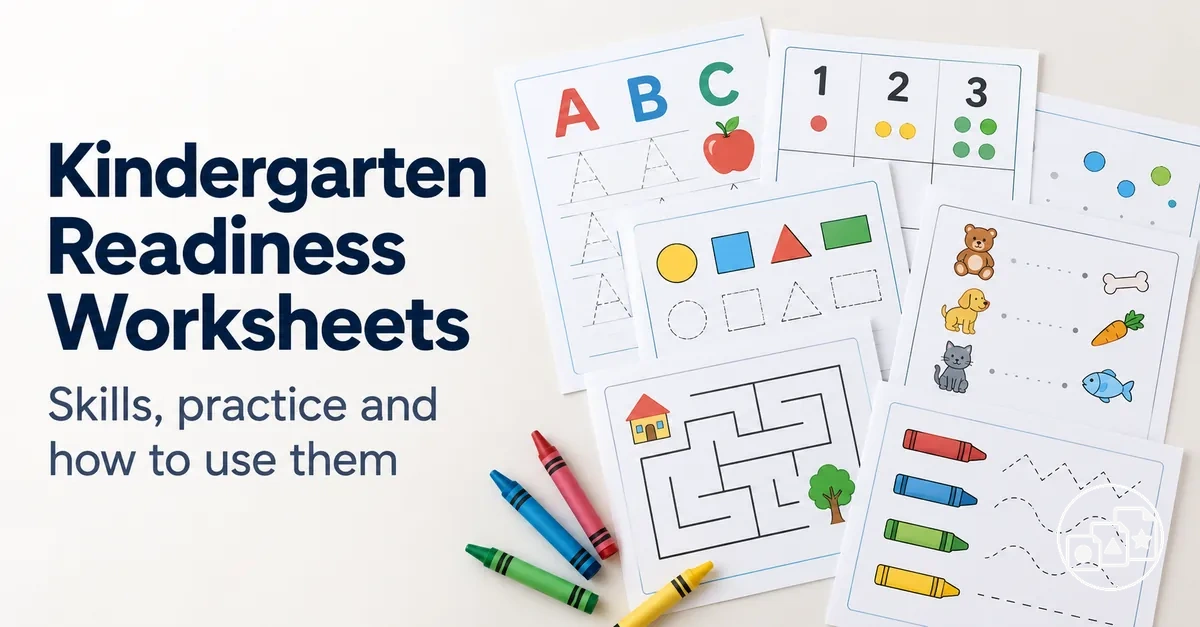
Use a worksheet with a clear purpose
The useful sequence is goal → matching task → observable response → next action. Keep the conclusion limited to the skill and conditions actually practised.
-
Choose one skill
Select an observable target such as controlled tracing, letter recognition, counting or matching.
-
Match the task
Use a worksheet that represents the target directly without adding unnecessary visual, cognitive or motor demands.
-
Observe the response
Look at how the child completes that task. The response is evidence about the practice target in that context, not readiness as a whole.
-
Choose the next action
Continue when practice is understandable and productive; model, simplify, change the mode or pause when confusion, frustration or fatigue reduces its value.
Use worksheets as one focused part of a broader readiness routine. Clear guidance can help a child understand the task, while play, reading, conversation, movement, routines and social interaction develop or reveal abilities that a paper task does not capture.
Table of Contents
The Role of Worksheets in Kindergarten Readiness
Worksheets within kindergarten readiness mainly provide focused practice for skills that can be represented through a simple, observable response.
A worksheet task can support reinforcement, familiarisation, and guided practice with marks, symbols, tracing, matching, or counting.
The practice goal should determine the worksheet task and the observed response used to judge that specific practice.
For example, if the skill target is controlled pencil movement, tracing a line provides a visible response to that targeted task.
The response can guide further reinforcement without being treated as evidence of broader readiness.
The illustration shows this practice goal, task, and response while keeping the wider learning context visible.

Whether a worksheet is useful depends on the child's current ability, situation, and whether the task is developmentally appropriate.
These conditions affect task fit rather than creating a universal rule for paper-based practice.
More specific guidance on when worksheets are appropriate before kindergarten belongs to the age- and situation-specific context.
Effective preparation places worksheets and hands-on learning alongside play, reading, conversation, and other richer experiences, so worksheet practice complements rather than substitutes for experiential learning.
Worksheets can provide practice evidence for a defined skill target, but that observed response cannot provide readiness evidence across broader development on its own.
Worksheet Practice and Readiness Assessment Serve Different Purposes
Worksheet practice rehearses a targeted skill, while readiness assessment gathers broader evidence about what a child can do across relevant domains and conditions.
A worksheet response provides practice evidence; readiness evidence draws on wider observation and supports a broader interpretation.
The comparison separates purpose, evidence, scope, and reasonable conclusion so a practice result is not mistaken for a readiness verdict.
These dimensions show what each activity is designed to do and what can reasonably be inferred from it.
| Dimension | Worksheet Practice | Readiness Assessment |
|---|---|---|
| Purpose | Rehearse or reinforce a targeted skill. | Gather broader readiness evidence across relevant domains and conditions. |
| Evidence | An observed response to a specific worksheet task, such as matching letters. | Observation and information from a broader range of activities and behaviours. |
| Scope | Narrow evidence about the skill being practised. | Broader evidence considered across multiple areas of readiness. |
| Reasonable conclusion | The response can suggest where further practice may be useful but does not necessarily establish broader readiness. | The combined evidence can inform a broader interpretation of a child's readiness, strengths, and areas needing support. |
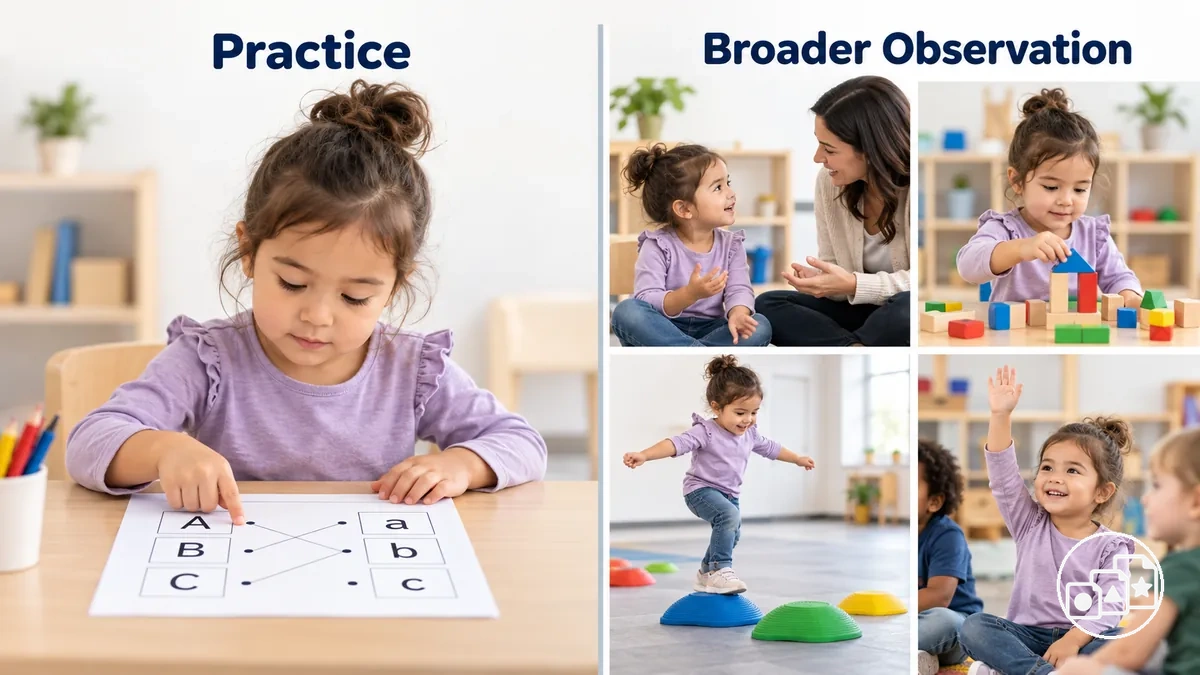
The image contrasts the narrow evidence from one focused worksheet task with observation across conversation, play, movement, and participation in other activities.
Completing or struggling with one worksheet does not necessarily establish a broader readiness conclusion; evaluation of strengths and gaps belongs within readiness assessment and skill gaps.
Skills Kindergarten Readiness Worksheets Can Reinforce
Kindergarten readiness worksheets are most suitable for skills that can be represented through a clear, observable task and a visible practice response.
A specific skill target, such as controlling a line, recognising a symbol, or matching a quantity, makes it possible to observe the response while keeping its interpretation limited to that practice context.
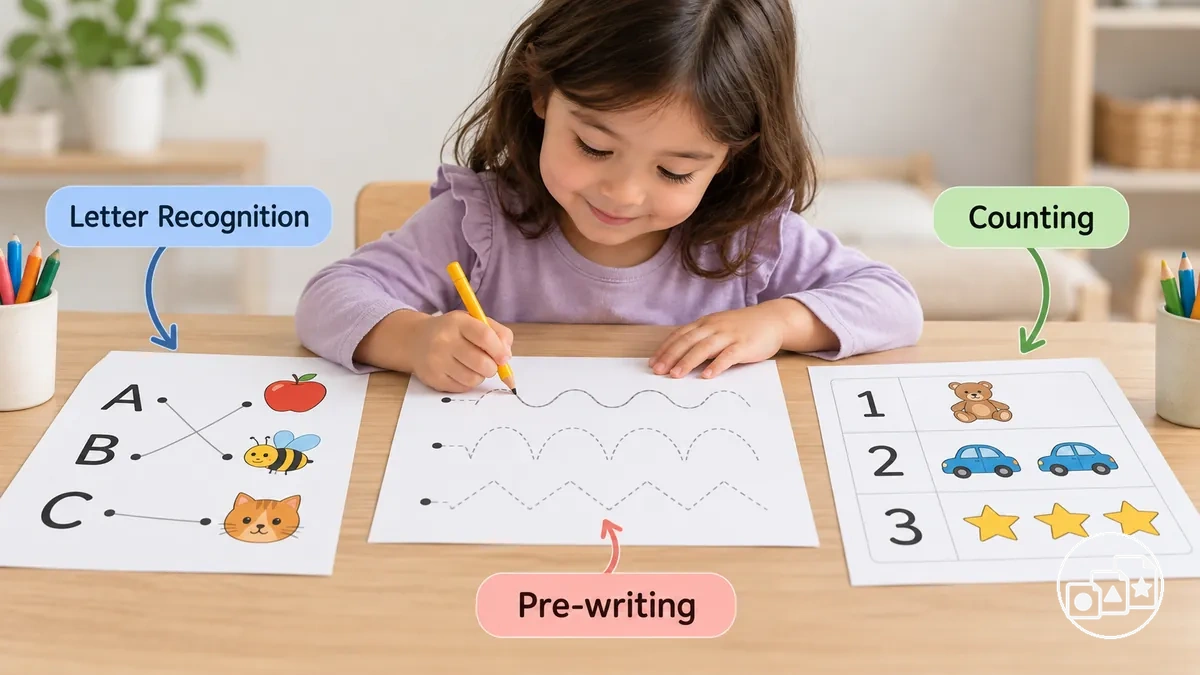
Worksheet-suited skills commonly include pre-writing and fine motor tasks, letter recognition and selected early literacy practice, and number recognition and counting.
These skill families can be represented through actions such as tracing, recognising, or matching because the task and response are visible on the page.
The illustration groups these selected skill families by connecting each one with an observable worksheet task while keeping them distinct from broader readiness abilities.
The following groups show representative skill properties and families that can be practised and observed clearly on a worksheet.
They are selected practice targets rather than an exhaustive readiness inventory.
- Pre-writing and fine motor: mark-making tasks where pencil control, tracing, or simple shapes produce an observable practice response.
- Letter recognition: tasks where letters or represented symbols can be recognised or matched.
- Early literacy: selected page-based tasks where represented literacy elements can be identified or matched through a clear response.
- Number recognition: tasks where numerals can be identified or matched through an observable response.
- Counting: tasks where pictured objects or quantities can be counted or matched to a represented numeral.
Social-emotional abilities, independence, communication, and gross-motor abilities remain part of the broader kindergarten readiness skills checklist, but they are better observed through contexts beyond worksheet responses.
Worksheet performance should therefore be interpreted in relation to the specific skill target, observable task, and practice response rather than as evidence about readiness as a whole.
Pre-Writing and Fine Motor Foundations
Pre-writing worksheet tasks involve fine motor control and visual-motor demands needed to make controlled marks on a page.
Pencil control and hand control support movements such as tracing, line tracking, and simple shape formation.
Different mark-making tasks place different demands on movement and control.
Tracing asks the child to guide a pencil or crayon along a path, while line tracking requires movement to follow a visual direction.
Copying simple shapes adds changes in direction and shape formation, while controlled colouring adds boundary control.
The observable response shows how the child manages that specific task demand without establishing a developmental threshold.
The image demonstrates how tracing paths, simple shapes, and boundaries require different kinds of control rather than measuring finished handwriting quality.
Its annotations make line control, direction, and boundary-following visible within the pre-writing task.
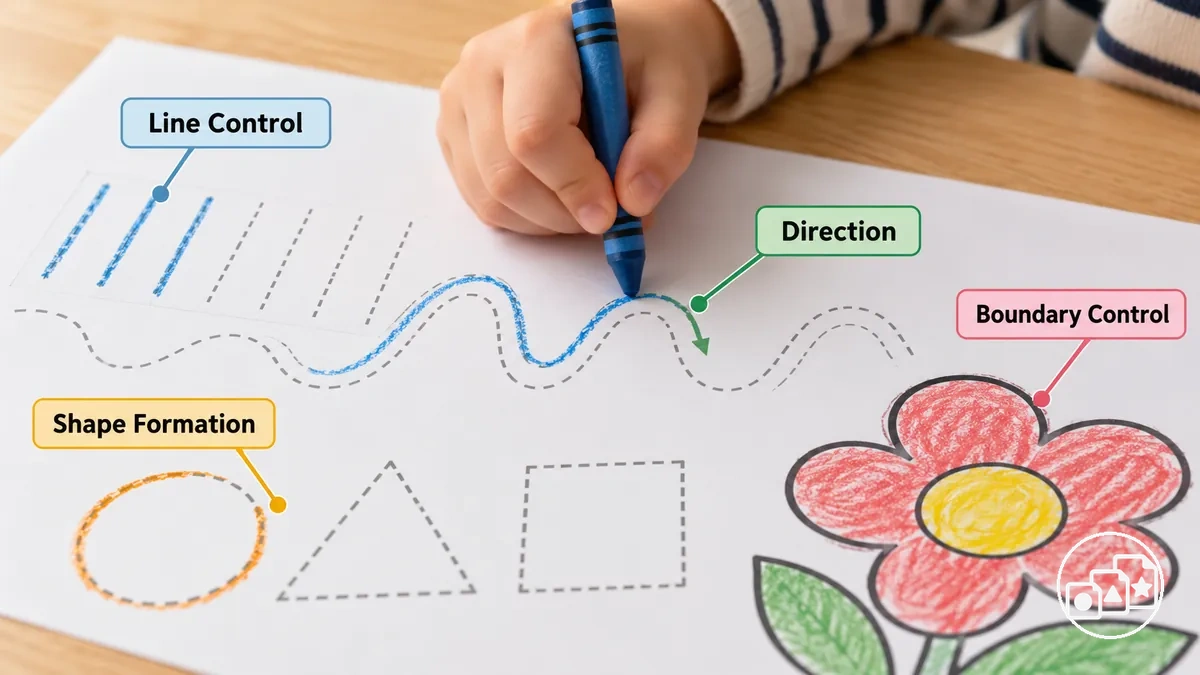
The task types below connect each worksheet form with the specific control it asks the child to practise and the observable response it can produce.
- Pencil movement: continuous mark-making requires the hand to direct a pencil or crayon across the page.
- Line control: following a line or path requires controlled movement in a specified direction.
- Tracing: following a represented path requires hand control in relation to a visual guide.
- Shape formation: copying simple lines or shapes requires changes in direction and controlled mark placement.
- Boundary control: colouring within a broad boundary requires movement to stop or change direction near a visible edge.
Worksheet performance provides practice evidence rather than a diagnosis, and neatness alone does not show how the child manages a specific motor or visual-motor demand.
Deeper development of pre-writing readiness skills can build on these tasks while keeping each observable response tied to its practice context.
Letter Recognition and Early Literacy Foundations
Letter recognition worksheets practise noticing, distinguishing, and matching letters or closely related sound cues.
Tasks can involve identifying an uppercase or lowercase letter, matching letter forms, or connecting a letter sound with a familiar cue.
Matching an uppercase letter with its lowercase form asks the child to recognise two forms of the same letter.
Identifying a named letter requires selecting the requested symbol, while a beginning sound task can require matching a familiar picture with its initial letter sound.
A correct response can indicate recognition within that specific task, but recognising a letter or matching a sound cue is narrower than demonstrating broader reading readiness.
The image illustrates several recognition relationships without presenting them as reading levels, while the task groups organize different recognition demands rather than stages of reading ability.
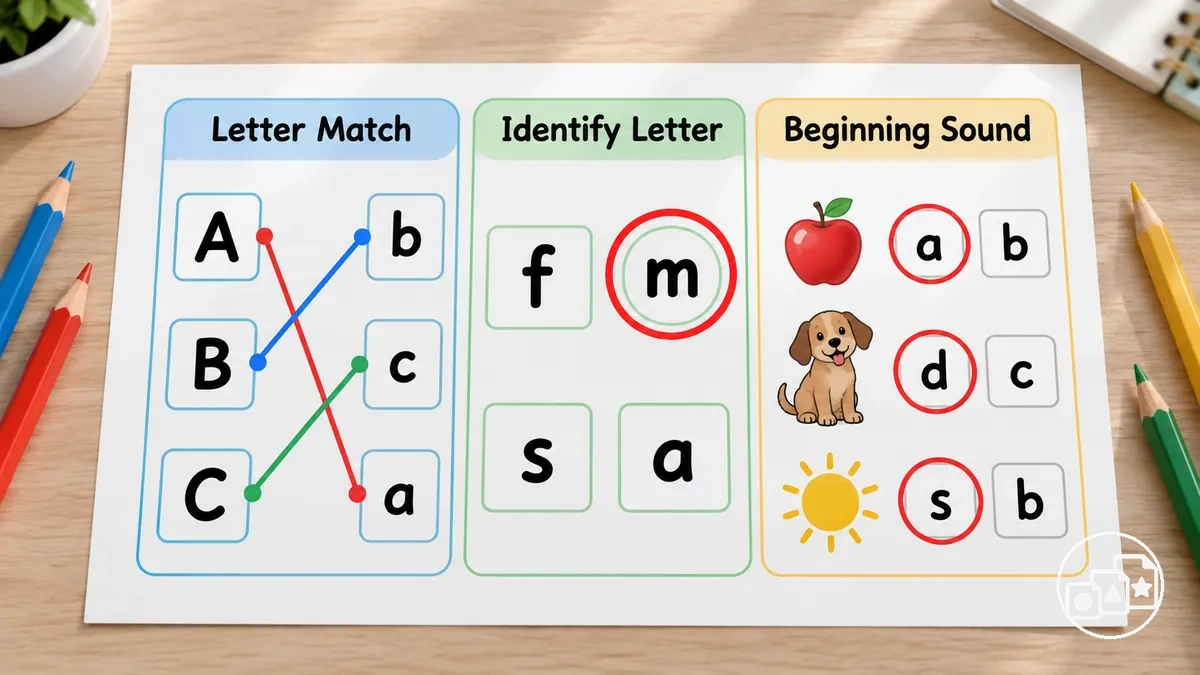
- Uppercase and lowercase matching: match two forms of the same letter to practise recognising their relationship.
- Named-letter identification: identify a specified letter among other letters to practise selecting the target symbol.
- Beginning-sound matching: match a familiar picture with the corresponding beginning sound or letter cue.
- Letter-picture association: connect a letter with a familiar picture representing that letter sound.
These responses provide letter recognition and early literacy practice rather than evidence of complete reading or phonics development.
Broader letter recognition readiness places worksheet-based recognition within a wider context of developing letter and sound knowledge.
Number Recognition and Counting Foundations
Number recognition and counting worksheets can practise identifying a numeral and connecting written symbols with quantities.
A numeral is a written symbol for a number, while counting and quantity tasks ask the child to connect that symbol with what the number represents.
Recognising the numeral 5 is a different task from counting five pictured objects or matching that numeral to a set of five objects.
Four distinct number-task relationships
- Numeral recognition
- Task: identify or select a requested numeral. Response: shows symbol identification within that task.
- Object counting
- Task: count pictured objects to determine the represented quantity. Response: shows quantity tracking for that set.
- Numeral-to-quantity matching
- Task: match a numeral with the set representing that quantity. Response: connects the represented quantity with its written numeral.
- Small-set comparison
- Task: compare clearly pictured sets. Response: shows whether the child distinguishes the represented quantities in that task.
These are distinct practice demands rather than stages of mastery.
Worksheet accuracy can show a response to a specific number recognition, counting, or matching task, but it cannot establish broader mathematical readiness by itself.
Deeper number recognition and counting guidance can build on these distinctions while developing foundational number sense.
Common Worksheet Activities for Kindergarten Readiness
Common worksheet activities are most useful to classify by the practice function they perform rather than by theme or appearance.
Tracing, matching, identifying, counting, sorting, a simple maze, colouring, and cut-and-paste activities can place different recognition, visual-attention, or motor demands on the child.
The table organises each activity type by its main skill demand, a representative task, and the practice response it is designed to elicit.
This makes recognition-oriented tasks easier to distinguish from tasks that require production or motor control, even when the worksheets look similar.
| Activity Type | Main Skill Demand | Example Task | What the Response Can Show |
|---|---|---|---|
| Tracing | Motor control and visual tracking | Trace a line or simple shape along a visible path. | The practice response can show how the child controls movement while following the represented path. |
| Matching | Recognition and association | Match two corresponding letters, symbols, pictures, or quantities. | The response can show whether the child recognises the relationship represented in that task. |
| Identifying | Recognition and selection | Identify a requested letter, numeral, shape, or familiar picture among alternatives. | The response can show recognition of the requested item within the choices provided. |
| Counting | Quantity tracking | Count pictured objects and select the corresponding numeral. | The response can show how the child connects counting a represented set with its quantity or numeral. |
| Sorting | Category recognition | Sort pictured items by a visible property such as shape or type. | The response can show whether the child applies the represented category distinction to the items shown. |
| Simple maze | Visual attention and pencil control | Guide a pencil through a simple path between a start and an end point. | The response can show how the child coordinates visual tracking with controlled pencil movement. |
| Colouring within a broad boundary | Boundary awareness and motor control | Colour a large shape while responding to its visible edges. | The response can show how the child manages pencil or crayon movement in relation to a boundary. |
| Cut-and-paste | Motor control and visual placement | Cut out a simple pictured item and place it in a matching location. | The response can show how the child combines manipulation with recognition and placement in that task. |
Recognition-oriented activities such as matching and identifying mainly ask the child to distinguish and select represented information, while tracing, colouring, mazes, and cut-and-paste tasks also require a produced motor response.
The activity type therefore changes the skill demand and the meaning of the observed practice response, so visually similar worksheets should not be treated as equivalent practice.
What Makes a Kindergarten Readiness Worksheet Useful for Practice
A useful kindergarten readiness worksheet has a clear practice goal and fits the target skill, the child’s current ability, and the intended practice context. A practical fit means the task is understandable with manageable support and its response mostly reflects the target skill rather than unrelated demands.
Strong skill alignment, task clarity, an appropriate challenge level, and an understandable response format help keep attention on the skill being practised rather than unnecessary confusion.
The criteria below evaluate the combined fit between the task, target skill, and child rather than any single decorative feature.
They should be judged together because weakness in one area can change what the child's practice response reasonably indicates.
- Skill alignment: The task should directly represent the practice goal; unrelated demands can make the response less informative about the target skill.
- Task clarity: Instructions and visual cues should make the required action understandable; unclear directions can add cognitive demand unrelated to the intended practice.
- Developmental fit and challenge level: The task should provide meaningful practice relative to the child's current ability; a task that is too easy may provide little new practice information, while excessive difficulty can obscure the target skill.
- Cognitive demand: The amount of information to notice, remember, or distinguish should support the practice goal; excessive visual load can increase confusion and make the response harder to interpret.
- Motor demand: The physical response should fit the skill being practised; unnecessary cutting, tracing, or pencil control can interfere when the intended target is recognition rather than motor practice.
- Response observability: The task should produce a response that can be connected to the target skill; an observable match, mark, selection, or count makes the practice response easier to interpret within that task.
- Fit with broader learning: The worksheet should support rather than replace relevant play, conversation, movement, or hands-on experiences when those experiences contribute to the skill being developed.
Same skill target, different task quality
Well matched
A letter-identification task presents a clear target with a small set of distinguishable choices, so the response can more directly reflect recognition.
Poorly matched
Crowded graphics and unrelated motor actions add extra demands, so an incorrect response may reflect recognition difficulty, task confusion or motor demand.
Key distinction: attractive graphics do not establish worksheet usefulness; the task needs to fit the skill and the child.
Worksheet fit can vary with the child's familiarity, current ability, and the specific task, so the same activity may provide different levels of useful challenge in different contexts.
Whether worksheets are appropriate for a particular age or situation requires a separate judgement beyond these practice-quality criteria.
Using Worksheets as Part of a Kindergarten Readiness Routine
A worksheet practice routine works best when worksheets are brief, goal-focused parts of a wider readiness routine rather than the routine itself.
Each worksheet session should connect one practice goal with a matching task while leaving room for play, reading, conversation, movement, and hands-on activity.
The sequence below organises purposeful worksheet use without prescribing a fixed daily schedule.
It moves from choosing a goal to observing the response before deciding whether to adapt, pause, or use repetition.
- Choose one practice goal: Identify the specific skill the worksheet session is intended to practise.
- Select a matching task: Choose a task that represents the practice goal without adding unnecessary demands.
- Explain or model the task: Give clear guidance so the child understands what response the task requires.
- Observe the response: Observe how the child approaches the task before deciding whether further practice would remain useful.
- Adapt, stop, or repeat appropriately: Adjust the task, pause the session, or use purposeful repetition according to the child's response and continued engagement.
Adjust the session from the child’s response
Continue
Keep going while the task remains understandable, productive and connected to the practice goal.
Clarify or simplify
Use more modelling or a simpler matching task when the demand is unfamiliar or unclear; reduce guidance once the child understands what to do.
Pause or stop
Shorten or end the activity when reduced attention, confusion, frustration or fatigue changes its practice value.
Frequency and duration: base them on the child, the task and ongoing engagement rather than a universal formula.
For example, after counting objects during a hands-on activity or conversation, a child might use a counting sheet to practise matching pictured quantities with numerals, then stop when attention begins to decline with fatigue.
Detailed guidance for using readiness worksheets at home can extend this general routine principle into home-use decisions.
Routine quality depends more on task fit and purposeful repetition than on the number of pages completed.
Signs Worksheet Practice Needs Adjustment
Rushing, guessing, persistent confusion, frustration, refusal, fatigue, or effortless completion can signal that the current worksheet practice needs adjustment.
The same observable behaviour may reflect task difficulty, unclear instructions, unfamiliarity, attention, motor demand, or reduced interest, so it does not identify one certain cause.
Use each behaviour as a signal to check the task and context, then make a small adjustment. The sequence is signal → possible explanation → check → adjustment; it does not treat the behaviour as proof of a developmental problem or single cause.
Signal → possible explanation → check and adjust
Repeated guessing
Possible explanation: This may reflect uncertainty about the task or limited familiarity with the target skill
Check and adjust: Check whether the child understands what the task asks, then model one example or simplify the task.
Rushing
Possible explanation: Rapid responses may reflect reduced attention, low challenge, or an attempt to finish quickly
Check and adjust: Check whether responses remain connected to the task, then change the practice mode or adjust the challenge.
Persistent confusion
Possible explanation: Confusion after an explanation may be related to unclear instructions, unfamiliar task structure, or excessive task difficulty
Check and adjust: Check whether a simpler explanation or demonstration changes the response, then clarify or reduce the task demand.
Frustration
Possible explanation: Increasing frustration can suggest that the current challenge, cognitive demand, or motor demand is interfering with productive practice
Check and adjust: Check whether the difficulty is tied to the target skill or another demand, then simplify the task or return to a prerequisite skill.
Refusal
Possible explanation: Refusal may reflect frustration, unfamiliarity, loss of interest, or the way the task is being presented
Check and adjust: Check whether changing the practice mode alters engagement, then pause or use a different form of practice.
Fatigue
Possible explanation: Slower responses, reduced attention, or declining engagement during the worksheet may reflect fatigue
Check and adjust: Check whether practice quality has changed during the session, then stop or shorten the worksheet activity.
Effortless completion
Possible explanation: Consistently easy completion can suggest that the task offers too little challenge for the current practice goal
Check and adjust: Check whether the child is responding accurately without meaningful effort, then select a slightly more demanding task or practise the skill in another context.
An observable behaviour is a signal to investigate, not confirmation of a broader developmental problem or one specific explanation.
Small adjustments to instructions, task difficulty, practice mode, or session length can show whether the response changes before broader conclusions are considered.